
Georgiy Kukhaleishvili, Expert of East European Council
In the political and expert circles of Ukraine and Western countries, the issue of increasing the effectiveness of anti-Russian sanctions has been repeatedly raised. As it turned out, it is not enough to break ties with the largest banks of the aggressor country, impose a ban on Russian oil supplies to Europe in tankers, and deprive Russians of access to advanced technologies. Arguments repeatedly surface in the media space that the Russian Federation freely imports prohibited goods, up to dual-use products, through third countries.
One such country is Georgia, despite the fact that 20% of its territory (Abkhazia and South) is under the occupation of Russian troops and there are separatist regimes sponsored by Moscow. The current government, led by the Georgian Dream party, has not yet joined the anti-Russian sanctions, refrains from providing military assistance to Ukraine and turns a blind eye to the use of its country’s territory for the transit of sanctioned goods to Russia, bypassing EU sanctions.
How did Russia drag Georgia into its adventures?
The value of Georgia for Russia lies in the fact that the shortest route for the delivery of goods from Europe and Turkey runs through its territory. Giorgi Mzhavanadze, a lawyer at the investment company TBC Capital, said that businessmen from the Russian Federation and Turkey use Georgia as a transit country, and the government does not interfere with this. According to TBC Capital, in the first half of 2022, transit traffic between Russia and Turkey tripled. Ivan Fedyakov, general director of the Russian consulting agency InfoLine, confirmed that the Georgian route helped Russia cover the need for spare parts for European-made equipment and various raw materials, in particular paper for the production of tea bags.
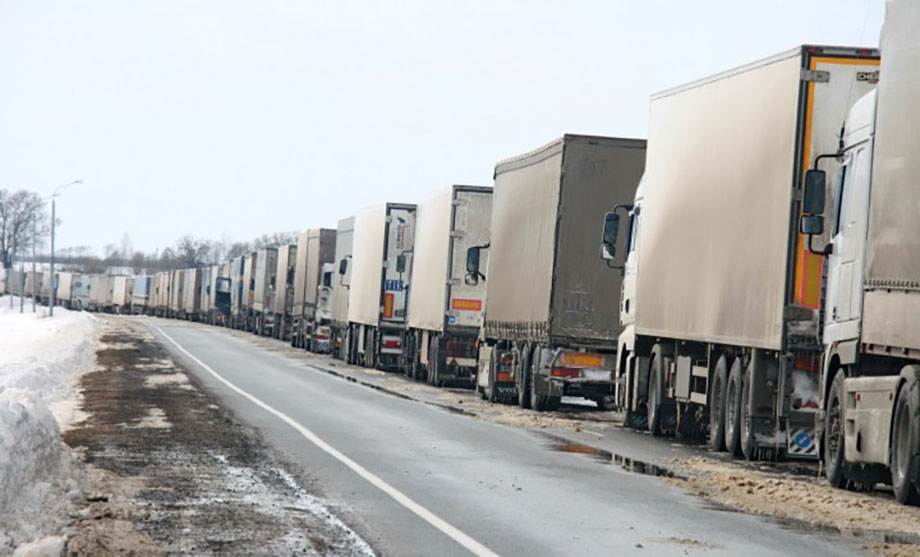
A line of trucks at the Upper Lars checkpoint. Georgian-Russian border
In Russia, there are companies that find goods for Russian business, and deal with their delivery, customs clearance and legal support. In particular, the Russian company Realexport delivers all kinds of goods from Georgia to Russia. Previously, the products that are of interest to Russian customers should be imported from the EU – for greater convenience when processing transactions, Realexport was looking for employees in Poland for remote work.
Most of the prohibited products are imported to Russia through Georgia by road. Additional lanes are being laid at Russian customs checkpoints, while the Chinese company China Railway 23rd Bureau Group is busy building a nine-kilometer tunnel under Cross Pass. This tunnel will allow drivers to bypass the dangerous Kobi-Gudauri section of the Mtskheta-Stepantsminda-Lars highway linking Russia and Georgia. In winter, this road is often closed due to the threat of avalanches. Apparently, the cargo is so plentiful and so important to Russia that the Georgian government had to initiate the construction of the largest tunnel in the South Caucasus in order to ensure uninterrupted supplies all year round.
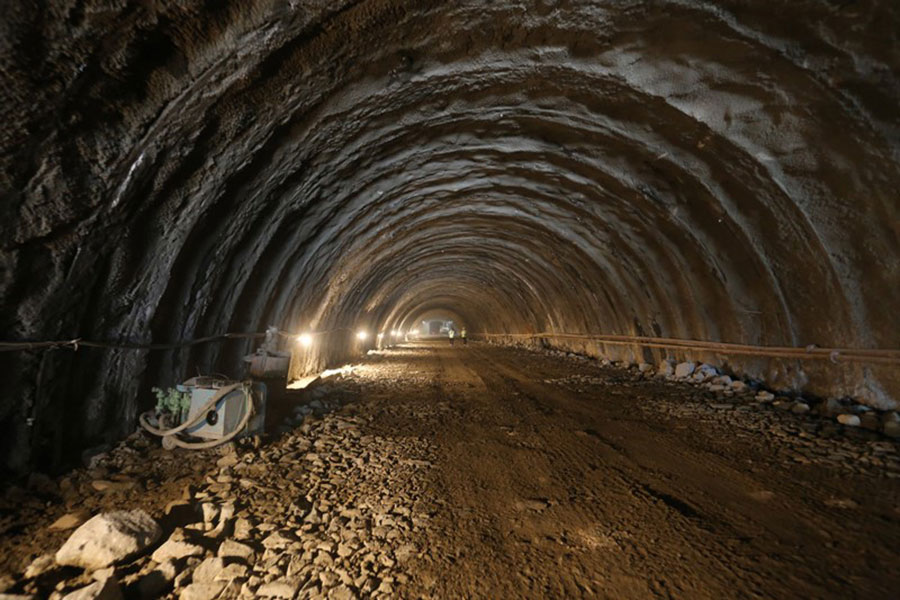
Construction of a tunnel
Alexander Davitidze, Chairman of the Association of Forwarders of Georgia, said that after the start of a full-scale Russian invasion of Ukraine, he began to receive e-mail requests from Russian residents for the transportation of various cargoes. Members of the association refused to take the sanctioned goods into work. Nevertheless, Davitidze does not rule out that small carriers could be tempted to transport prohibited goods. According to the Prime Minister of Georgia, Irakli Garibashvili, 3-4 thousand cars a day pass along the Mtskheta-Stepantsminda-Lars highway, of which 30% are trucks (approximately 900-1200 trucks a day).
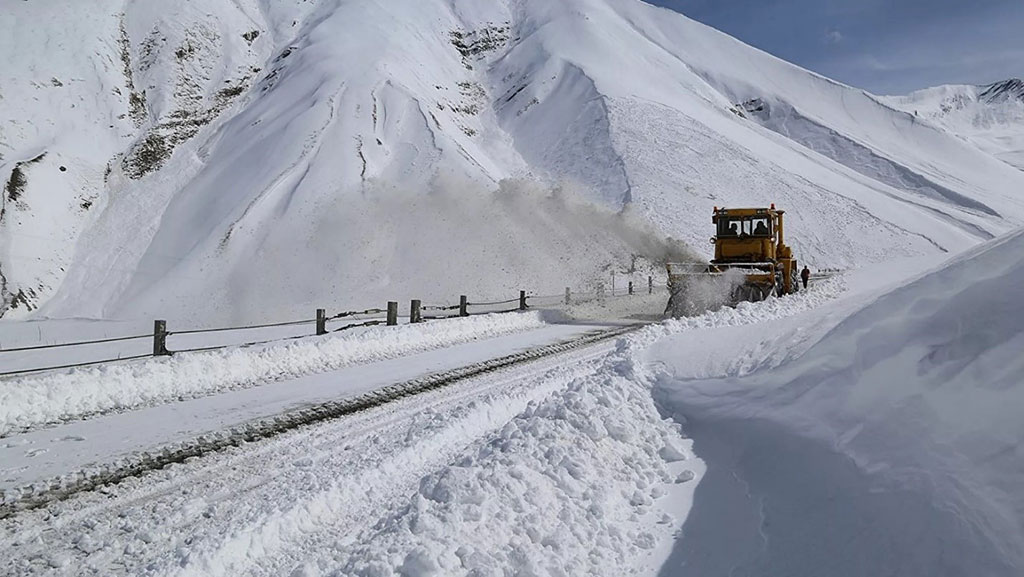
Kobi-Gudauri section of the Mtskheta-Stepantsminda-Lars highway
Georgia’s geographic location also benefits European businesses, which have lost the opportunity to enter into contracts with Russian companies due to sanctions. While the war is going on in Ukraine, the Dutch company APM Terminals, which is a division of the Danish company AP Moller-Maersk, is investing in expanding the capacity of the seaport of Poti. According to Ian Rawlinson, commercial director of APM Terminals Poti, the project is designed to increase the volume of cargo deliveries to the countries of the South Caucasus and Central Asia. In 2020, the company’s total revenues decreased by 13%, but its division APM Terminals Poti, on the contrary, increased profit by $1.71 million.
APM Terminals terminated business ties with the Russian Federation after a full-scale invasion of Ukraine. But the Dutch clearly do not care about the suspicious increase in the volume of Russian-Georgian trade and the likelihood that the final recipient of most of the cargo delivered to the port is Russia, and not Kazakhstan or Azerbaijan. According to preliminary data from the National Statistics Office, in 2022 Georgia exported products to Russia worth $651.62 million, which is 6.38% more than a year earlier. Last year, the volume of imports from the CIS countries (mainly the Russian Federation) to Georgia increased sharply – $ 3.05 billion, which is 24.26% more than in 2021.
Notably, Georgia has dramatically increased exports to Russia since April 2022, after the EU imposed new sanctions packages on March 9, March 15 and April 8. If in March Georgia supplied goods worth $16.95 million to Russia, in April the volume of exports increased to $46.61 million. Georgian exports to the Russian Federation reached their peak in July ($82.58 million) after another batch of restrictive measures from the EU. In the second half of 2022, Georgian exports to Russia ranged from $53 million to $70 million per month.
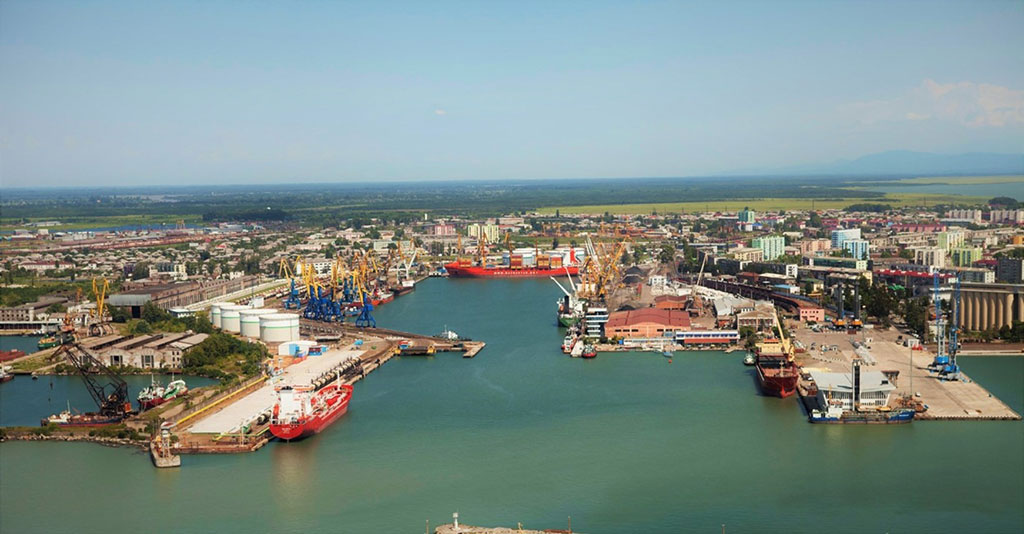
Port of Poti
What banned products does Russia import through Georgia?
Official Tbilisi denies any arguments of the Ukrainian special services and well-informed Georgian citizens regarding the transportation of sanctioned goods to Russia through the territory of Georgia. In April 2022, the Ministry of Finance of Georgia stated that from the first days of the introduction of international sanctions against the Russian Federation, the republic has exercised strict control at customs checkpoints and has been monitoring incoming and outgoing cargo. However, in the export and import records of the National Office of Statistics of Georgia, you can find over 40 items that are subject to EU anti-Russian sanctions.
This is not about paper for tea bags, but about dual-use products, spare parts and electronics that are used in the military-industrial complex of the Russian Federation. The National Statistics Office of Georgia is silent about the countries of destination or origin of goods. However, it is not difficult to guess who exactly is the final recipient of the sanctioned products, given that in 2022, export volumes went off scale in a number of positions, unlike in previous years.
In 2022, Georgia increased the export of fuses and detonators by 98.57%, explosive mixtures by 75.39%, landing gear for aircraft by 86.41%, radio navigation aids by 30.76%, navigation devices for radio direction finding and compasses by 99.96 %, diesel and semi-diesel (petroleum) engines with a capacity of 75-375 kVA by 86.91%, valve generators with a capacity of 75-375 kVA by 98.65%, reinforced glass by 59.89%, pneumatic tires for cars, buses, trucks , aircraft by 34.26%. Last year, Georgia exported spare parts for turbojet engines in the amount of $57.2 thousand, as well as non-aeronautical gas turbine engines with a capacity of over 5 thousand kW in the amount of $2.73 million, although it did not supply these products in 2021.
The listed products can be used for the production of ammunition, the manufacture or repair of aircraft, ships and equipment. The specified nomenclatures are forbidden to be delivered to Russia, according to the directives of the European Council 2022/1904, 2022/1269, 2022/394, 2022/428, 2022/576, 2022/879. To all appearances, the Russians are importing products of interest to Georgia in advance. In 2022, Georgia imported fuses and detonators alone, explosive mixtures and landing gear for aircraft worth over $20 million, which is 71.3% more than in 2021. It is no wonder why Russian rockets, shells and air bombs have been falling on the heads of millions of Ukrainians for more than a year now.
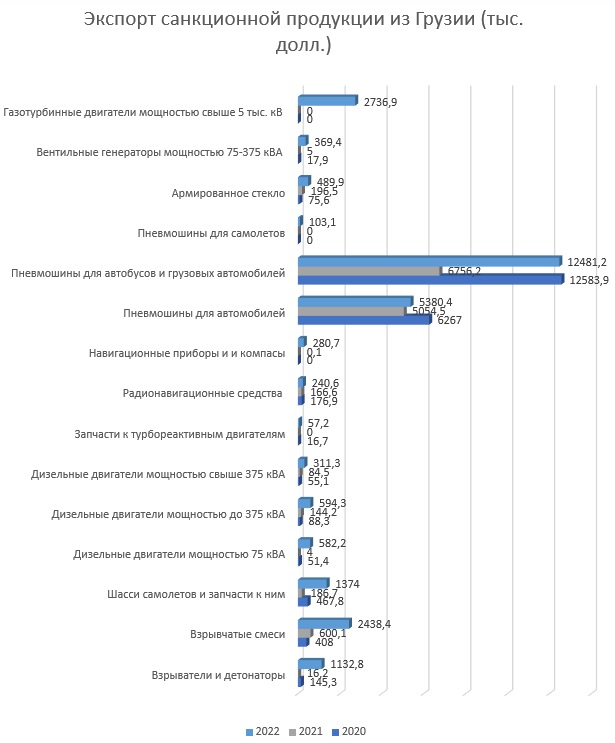
Analysis based on data from the National Office of Statistics of Georgia
By the way, back in April 2022, Deputy Prime Minister of Ukraine Irina Vereshchuk called on Georgian citizens to prevent arms smuggling for Russia through their territory, and the Main Intelligence Directorate of Ukraine reported on Russian plans to import sanctioned goods through Georgia, including military and dual-use products . Khatia Dekanoidze, a Georgian deputy from the opposition United National Movement party and former head of the National Police of Ukraine, suspects Russia of using Georgia to circumvent sanctions.
Last year, Georgian exports of various electronics grew exponentially, which can be found on the lists of products prohibited for delivery to Russia, according to European Council Directives 2022/576, 2022/1904. According to the National Statistics Office, in 2022, Georgia increased the export of plug connections by 46.53%, network switches by 50.45%, automatic circuit breakers by 39.72%, photovoltaic cells by 93.92%, fiber optic cables by 92.08%, and audio amplifiers by 60.95%, over the previous year. Last year, Georgia exported insulating joints made of ceramics for electrical equipment in the amount of 30.6 thousand dollars, while increasing imports of these materials by almost 42%.
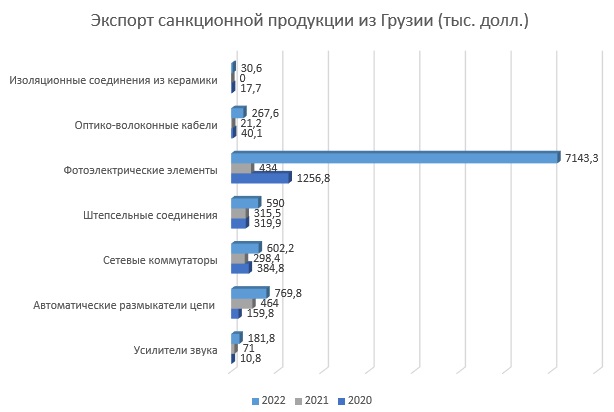
Analysis based on data from the National Office of Statistics of Georgia
Due to sanctions, Russian citizens have lost the opportunity to directly buy microchips manufactured by Marvell, Intel, Holt, ISSI, Microchip, Micron, Broadcom, Texas Instruments (USA), Renesas (Japan), Infineon (Germany), Vicor chips and AirBorn connectors (USA). Chris Millier, an analyst at the American Enterprise Institute, believes that Russia purchases various microchips through distributors in third countries, since they are widely available for sale on international markets and are used in the civilian sphere.
Among the Georgian export items, there is a noticeable increase in the supply of household appliances and industrial equipment, which most likely contain electronics needed by Russian industrialists. U.S. Commerce Secretary Gina Raimondo, European Commission President Ursula von der Leyen, director of the Russian nonprofit Internet Defense Society Mikhail Klimarev, and German Friedrich-Alexander University professor Roland Nagy agree that some of the microchips used in washing machines, refrigerators, breast pumps, and other equipment can be reprogrammed and used in sophisticated weapon systems. The Ukrainian military found foreign chips and microcircuits in downed Russian Orlan drones and wrecked enemy armored vehicles. Mikhail Klimarev estimates that 100 microchips are enough to make about 50 Russian missiles.
According to the National Statistics Office of Georgia, exports of refrigerators (+82.55%), vacuum cleaners (+65.18%), electric heaters (+65.26%), external hard drives (+55.92%) increased astronomically in 2022. , plastic cards with integrated circuits (+99.39%), cookers (+70.41%), stereo microscopes (+98.21%), components for microphones and headphones (+99.88%), washing machines (+ 80.29%). These products are prohibited from being shipped to Russia in accordance with European Council Directives 2022/428, 2022/576, 2022/1904. In addition, Georgia increased the export of milking machines (+98.14%) and equipment used in the dairy industry (+91.67%).
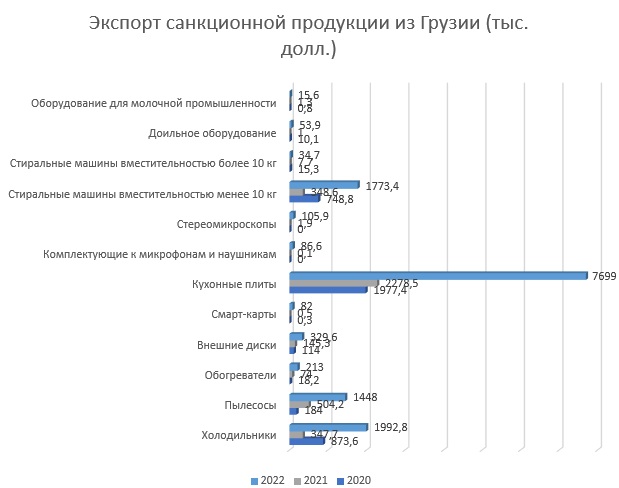
Analysis based on data from the National Office of Statistics of Georgia
All this is only a small part of the goods that Russia freely imports, bypassing international sanctions. After all, even those positions that are not related to the military sphere are banned. For example, last year Georgia increased the export of equipment for the mining industry, including coal saws (+99.98%), crushers (+60.96%), equipment for separating, selecting and washing rocks and minerals (+98.65 %), bulldozers and angledozers (+83.94%). Last year, Georgia increased the export of building materials such as Portland cement (+99.99%), cement clinker (+99.98%), building stone (+48.15%), artificial stone (+53.30%). These positions are subject to anti-Russian sanctions, in accordance with European Council Directives 2022/576, 2022/1269.
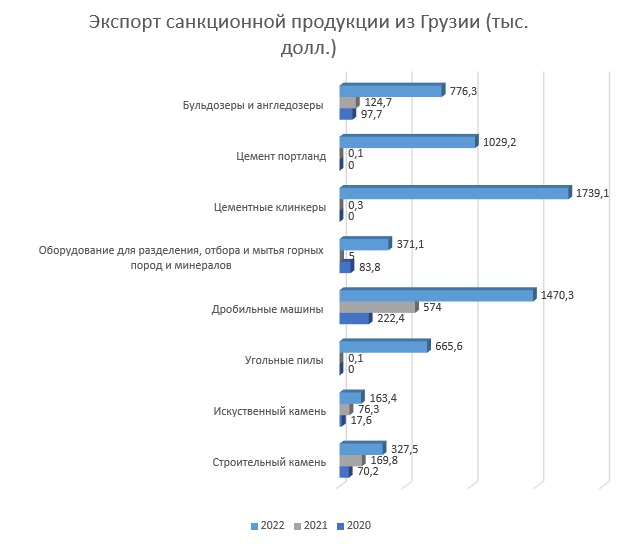
Analysis based on data from the National Office of Statistics of Georgia
Conclusions for Ukraine and Europe
Georgia is one of many examples of how Russia circumvents international sanctions thanks to third countries and, despite prohibitions, buys everything it needs from America and Europe to manufacture weapons and continue the endless war in Ukraine. The Russian Federation uses Azerbaijan, Armenia, Kazakhstan, Kyrgyzstan, India, Turkey, China, Malaysia and, possibly, other countries that do not participate in the policy of anti-Russian sanctions and remain neutral in the Ukrainian-Russian war in parallel import schemes.
For example, in August 2022, Kazakhstan imported $21.4 million worth of refrigerators from Europe, which is three times more than in the same period of the previous year. The Central Asian Republic has significantly increased the supply of refrigerators, washing machines, electric breast pumps to Russia. Armenia tripled the supply of electric breast pumps to the Russian Federation in the first half of 2022, despite a decrease in the birth rate in the country by 4.3%.
Thanks to the supply of prohibited products to the Russian Federation through third countries, the effect of sanctions is reduced. Of course, restrictive measures are depleting the Russian treasury and its reserves. According to Ivan Us, the chief consultant of the department of foreign economic activity of the National Institute for Strategic Studies, the budget deficit in the Russian Federation is already 60%, and since August the aggressor country will not be able to cover expenses without issuing money, which will lead to the depreciation of the ruble. However, the impact of the sanctions could have been more damaging to the Russian economy if there were no loopholes through Georgia and other countries. Thanks to parallel imports, the Putin regime is still managing to keep the Russian economy afloat. In 2022, Russia’s GDP shrank by only 3% and an economic collapse was avoided.
The advantage of the Russian Federation is that not only Russian business and the military benefit from parallel imports, but also residents of third countries who get involved in adventures for the sake of profit. In 2022, Georgia’s GDP grew by 10.1% due to an increase in trade with the Russian Federation, the number of money transfers from Russian citizens to local banks, and the hype among Russians to buy and rent real estate in Georgian cities. In exchange for helping to circumvent sanctions, Russia supplies wheat flour and oil products to Georgia at a discount.
The Russians work with their people. Russia has chosen Georgia as a route for the delivery of sanctioned products from Turkey because there are close ties between the political and economic elites of the two countries. In April, two audio recordings were published on the YouTube channel Cyber Kmara, the essence of which is that the owner of the Russian company Sistema JSFC, Vladimir Yevtushenkov, asks Bidzina Ivanishvili, a Georgian businessman, ex-prime minister and founder of the ruling Georgian Dream party, for assistance. According to one version published in the Georgian media, the entrepreneurs agreed on the supply of Russian grain to Georgia.
However, one should not forget that one of Yevtushenkov’s assets, the RTI Systems enterprise, develops and produces for the Russian army drones and radar stations used to detect and track ballistic and cruise missiles. It is quite logical that Yevtushenkov’s business, like other Russian high-tech companies, is experiencing a shortage of imported electronics due to sanctions, which can be brought to the Russian Federation through its people in Georgia. It is not surprising why Ukraine has imposed sanctions against the Ivanishvili family and his entourage.
To increase the effectiveness of anti-Russian sanctions, it is necessary to cut the supply routes of parallel imports to Russia through third countries. The political and economic elites of Georgia and other countries must clearly realize that they will face the same sanctions that the Russians faced if they continue to work with them at the expense of European security.
Average Georgians are already suffering from the economic boom in Georgia on the bones of Ukrainian citizens. Georgia has become a cesspool for Russian citizens who evade conscription or want to avoid the consequences of anti-Russian sanctions. This mainly concerns Russian IT workers, owners of online stores, who, due to the restrictive measures of the West, cannot receive money transfers from customers from developed countries or find orders. There are 17,000 companies founded by Russian citizens in Georgia.
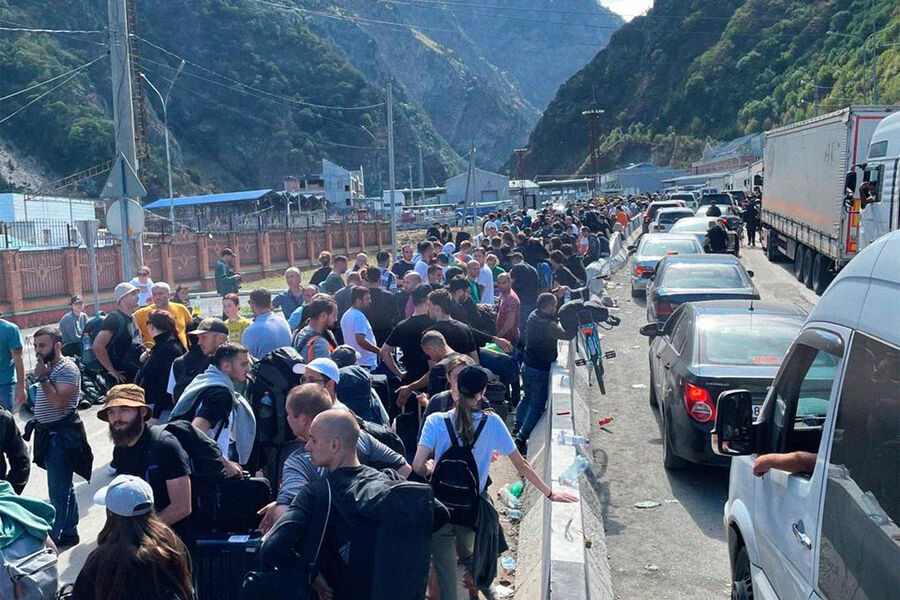
Russian citizens cross the Russian-Georgian border
Due to the influx of Russians in Georgia, real estate prices are rising. For example, renting a one-room apartment in a residential area of Tbilisi now costs at least $350-400 per month. Rising prices in shops and catering establishments. The increase in the number of Russians in Georgian cities is spurring the growth of social tension, which in the foreseeable future may result in a new conflict.

Ukrainian rally in Tbilisi on February 24, 2023
Russian citizens in Georgia are the fifth column of the Kremlin. Soon they will begin to demand the legalization of the Russian language in the business sphere, to demand that it be taught in schools and universities. Russians who hole up in Georgia are no different from their compatriots in Russian cities and support the idea that Russia and Georgia should be connected as in the years of the monarchy, are skeptical about integration into the EU and NATO. The Baltic countries faced such problems.
It should be understood that the official position of Tbilisi contradicts the beliefs and sentiments of a significant part of the Georgian society. More than 3,000 Georgian volunteers, which is a lot for a country with a population of 3.5 million people, are shedding blood in battles with Russian invaders in Ukraine, local volunteers are raising money for diesel generators and humanitarian aid to Ukrainians, and opposition parties and journalists are organizing protests in Tbilisi against Russian aggression. A significant part of the Georgians do not hide their contempt for the “come in large numbers” Russians.
Georgians must understand that situational advantage and easy money from the pockets of Russians are not worth international isolation and degradation in the frames of the Russian world.