
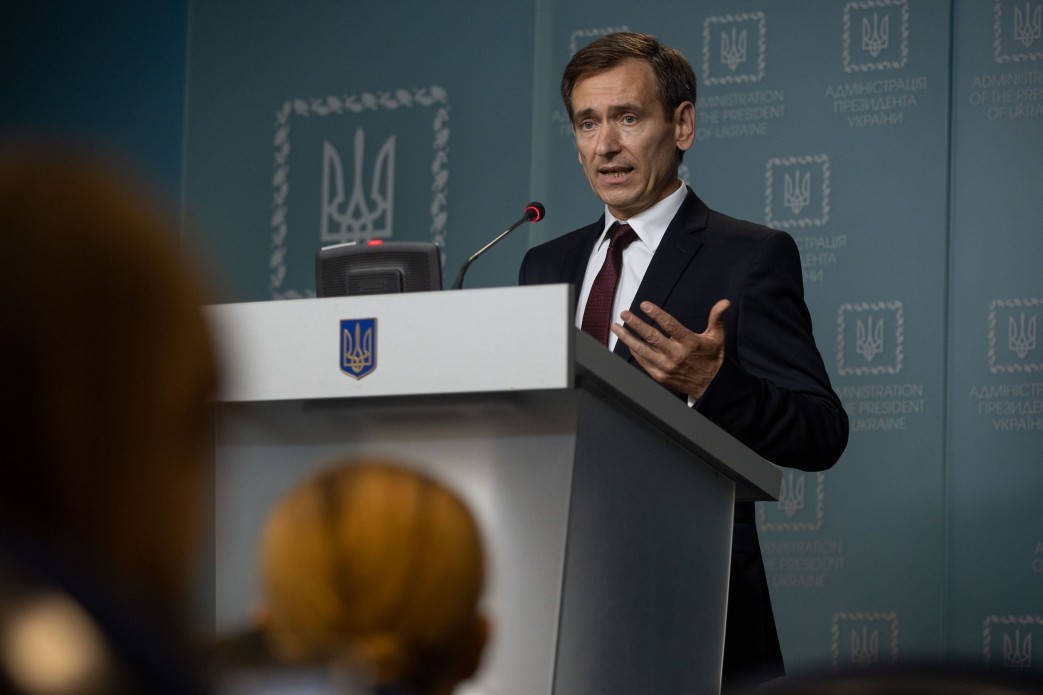
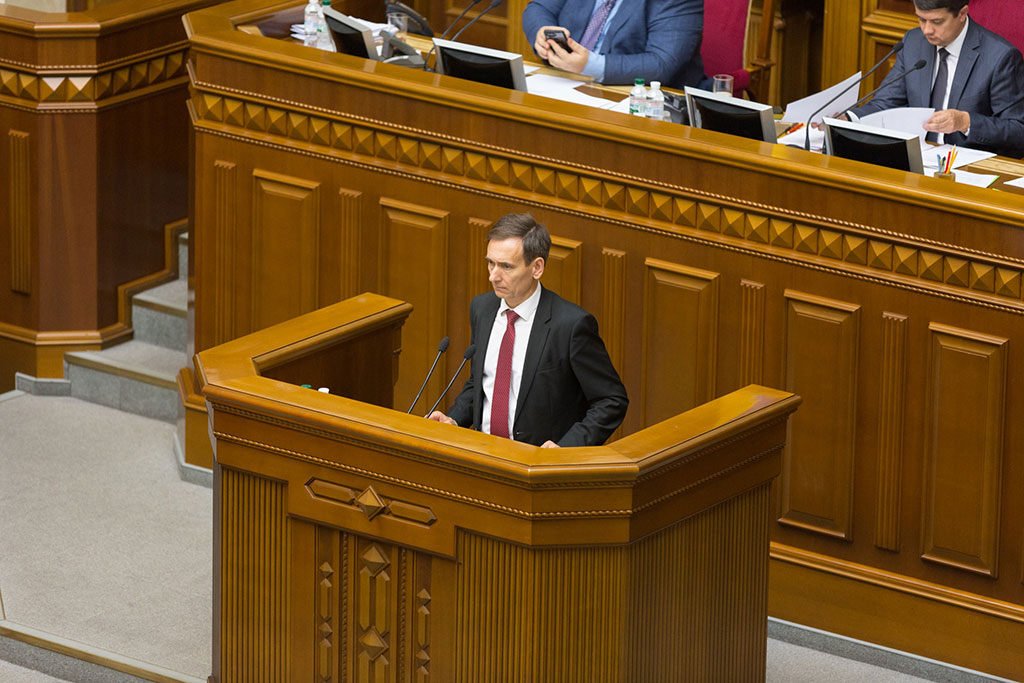
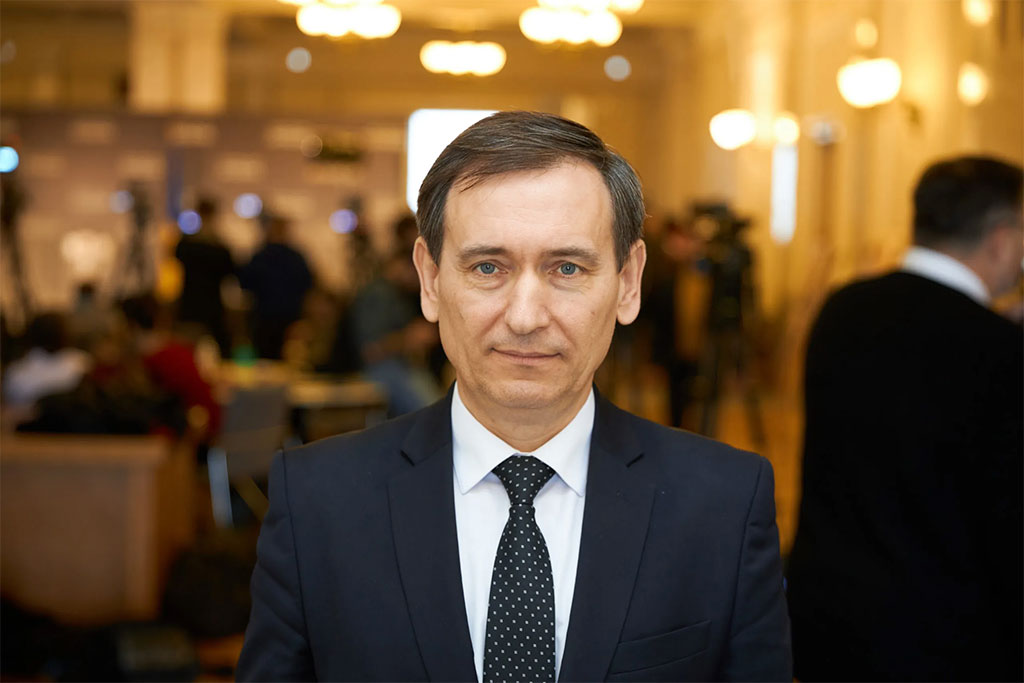
Ukrainian Deputy, Representator of President in Parliament Fedir Venislavskiy in exclusive interview answered directly on very important questions: mobilization in Ukraine, possible mobilization of Ukrainian citizens abroad, when the war can be finished, why is impossible to organize election in Ukraine this year
Interview was presented for East European Council by journalist Michał Kacewicz
M.K.: What is the situation with mobilization in Ukraine?
F.V.: Mobilization in Ukraine will be within the framework of the General Staff and the Command of the Armed Forces plans. There are no “waves” or “jumps” of mobilization. The mobilization is going according to plan.
The main mobilization measures were carried out in Ukraine from February 2022 to around June 2022, when we were forced to increase the number of our armed forces by almost three times. We can say that from the last summer that main mobilization measures have ended. Now there is an absolutely planned monthly replenishment of losses that we bear both – in the form of wounded and, unfortunately, in the form of dead soldiers.
Therefore, there are no some significant problems in this absolutely systematical process, but there are some certain conflict situations related to the fact that a small number of people liable for military service do not want to mobilize, do not want to serve. They don’t want to fight. It is natural because people are afraid. There is nothing wrong with that, but there is a correlation of values. The value of protecting your country, its sovereignty.
In fact, we are now fighting for the very right to existence of the Ukrainian state and the Ukrainian nation, so I think this should be understood by some liable for military service who, unfortunately, do not want to serve.
In these examples, we face some conflict situations during the delivery of subpoenas, but it is not a very large-scale phenomenon.
Nevertheless, there is a certain number of persons liable for military service who evade it. For example, a man has given subpoena in Rivne region, but doesn`t want to take it, because he registered is Sumy, Kharkiv or Zaporizhzia region and says: “I will go there and take it personally”. But after it doesn`t come and runs from his obligations.
Therefore, as a lawyer, I came up with the idea that we can extrapolate the situation with the register of debtors who do not pay for utilities, other obligatory payments, for taxes, and so on. We have such open registries. Anyone can get information from them. Therefore, when a person does not fulfill his constitutional duty, his duty to defend his homeland, to defend honestly, I think that others should know about this person.
On the one hand, I think it will be a powerful psychological factor, but on the other hand, I think that if a person gets into this register, and then in the future he wants to engage in politics, then he is unlikely to have such an opportunity
Such idea appeared. How it can be implemented? We will see. The bill has already been taken into work. It’s on my desk, we’re just still holding consultations so as not to violate in any way the norms of international human rights law, the international universal declaration, the international covenants of the human rights conventions. So, we continue to work.
M.K.: And what are the ideas if a person runs away from the army, if he leaves, and how to find him?
F.V.: Very simple ideas. Today, we have a law in Ukraine on an electronic registry of people liable for military service, that means all of them are enlisted and information about them is kept electronically.
There are means of communication – for example, telephones numbers. We have a lot of various information bases in the state that can be used to properly inform a person that he needs to come to the recruiting station and go through the appropriate mobilization procedures.
So, I don’t think it’s a problem at all. We can do it. If a person is informed twice that he must come to the recruiting station, but he does not do this, then information about this person can be made public.
M.K.: Will this also apply to people in Poland?
F.V.: We are also thinking about this in order to extend this to those citizens of Ukraine who are abroad, who are also properly informed that they should come and fulfill their duty.
M.K.: How long can the war continue?
F.V.: We believe that this year we can win the war. I think there is a chance for it.
M.K.: It would be great, but what if not?
F.V.: You know, in this case there are sociological surveys of Ukrainian people. More than 80-90% percent of citizens are ready to fight until we completely release our territory from Russia within the frames of 1991, including Crimea.
M.K.: Here in Poland, we do not have much information about such a tragic process as compensation for the families of the dead soldiers. How does this process take place in Ukraine? Are there any problems with that? Because it demands big expenses…
F.V.: Very big. But these costs are included in the state budget. If the fact of the death of a soldier is established for 100%, his family receives 15 000 000 UAH (about 400 000 USD).
M.K.: That’s a lot of money…
F.V.: Yes, but human life is priceless. Therefore, the question here is not money, but the question of justice, and we keep the process. Sometimes problems arise when there is no reliable information that a person died. There are missing people who may have died or may be in captivity. When there is information about a person that he is in captivity, this is the other situation, then the family does not receive this compensation.
We are constantly searching for our dead soldiers, exchange with Russia. We take the bodies of our servicemen who died on a frontline and give back bodies of Russian soldiers.
The process is underway, and as soon as there is a 100% fact of death, the family receives compensation. There are no problems with this today.
M.K.: I also want to ask about the political situation. Elections are going to take part this year, if I am not mistaken…
F.V.: According to the schedule, yes, this year, but from the point of view of processes, it is almost impossible that they will happen this year.
The constitution clearly states that both the Verkhovna Rada the President, whose term ends during the martial law, continue to perform their functions until the end of martial law.
Therefore, elections will take place when martial law becomes terminated. Further, electoral processes will be started by a central election commission, and this will take at least six months. Therefore, I think if we manage to end the war this year, then most likely the elections can take place in the spring, summer of next year.
M.K.: How do you think the political landscape in Ukraine can change after the war? There may be some new political forces here. What do you think about possibility of creating some type of military party?
F.V.: Without a doubt, the military personnel and military leaders who will guarantee the victory of Ukraine, they will get support. Therefore, I think that they will either join some existing political forces, electoral party lists, or some new political forces that can be created. I think that in the future Parliament we will have many war heroes. No one will have any doubts about this, so we’ll see.
M.K.: Are there any signs of political activation of these people?
F.V.: Now question number one is war and victory. Therefore, there are no political projects related to the military leadership now.
M.K.: What does the end of this war look like for Ukraine? Will there be a peace treaty?
F.V.: After the war, the agreement must definitely be peaceful. It must include compensation for the losses that Ukraine has suffered, for citizens, for the state, and for enterprises and businesses.
I will emphasize once again that for us victory means the complete liberation of all temporarily occupied territories from the enemy. Will we succeed? I think that we will succeed. We are now striving for this and creating the prerequisites, and then, of course, some kind of peace treaties will be signed that will provide for various guarantees, including post-war security.
M.K.: In Poland, there is no doubt that this should be the case, but, it seems, in other countries, for example, in Austria….
F.V.: Statistics show that Austria has the largest concentration of Russian diplomats in the world. That is, there are about 1,500 Russian diplomats in Vienna. Therefore, Vienna is such an interesting city, and Austria is an interesting country, where the Russian role of agents of influence is still strong.
Nevertheless, we were on a working trip with colleagues from our committee, in Vienna and talked a lot with politicians. We communicated with a representative of the Ministry of Defense, the Ministry of Foreign Affairs, our colleagues from the Parliament.
They say very clear: “We have military neutrality, but we do not have political neutrality”. Politically, we are completely on the side of Ukraine. The military, yes, we cannot supply weapons, but politically, we are completely on the side of the entire Western world.
M.K.: But here the question is not only not only in Austria. There is a “peace plan” of China. In Europe, especially in Germany, Italy, maybe even France, there are supporters of the so-called compromise.
F.V.: Compromise, which implies some kind of territorial concessions to the aggressor, is in principle not unacceptable for our government and for our people. Such compromises can be in the minds of politicians who live in a quiet peaceful space, where rockets do not fly. And when permanently we have attacks on our cities, it is unlikely to talk about any compromises.
Oleg Dunda: “Moscow will not influence anything, and Kyiv will attract new states”
We are one Facebook.
*Our platform gives opportunity to politicians and experts to present their view and position in the interview. That fact doesn’t mean that our opinion always correlate with opinion of speakers.