
Anton Naichuk, Ph.D, the head of East European Council
Are there options to find solution for “Transnistria” case? What approaches and plans are chosen by Moldavian authorities? War in Ukraine and its influence.
Ukraine acts as an outpost for containing and countering Russian military aggression in Europe, and the main emphasis of the international community is aimed at supporting the military potential and economic stability of the Ukrainian State.
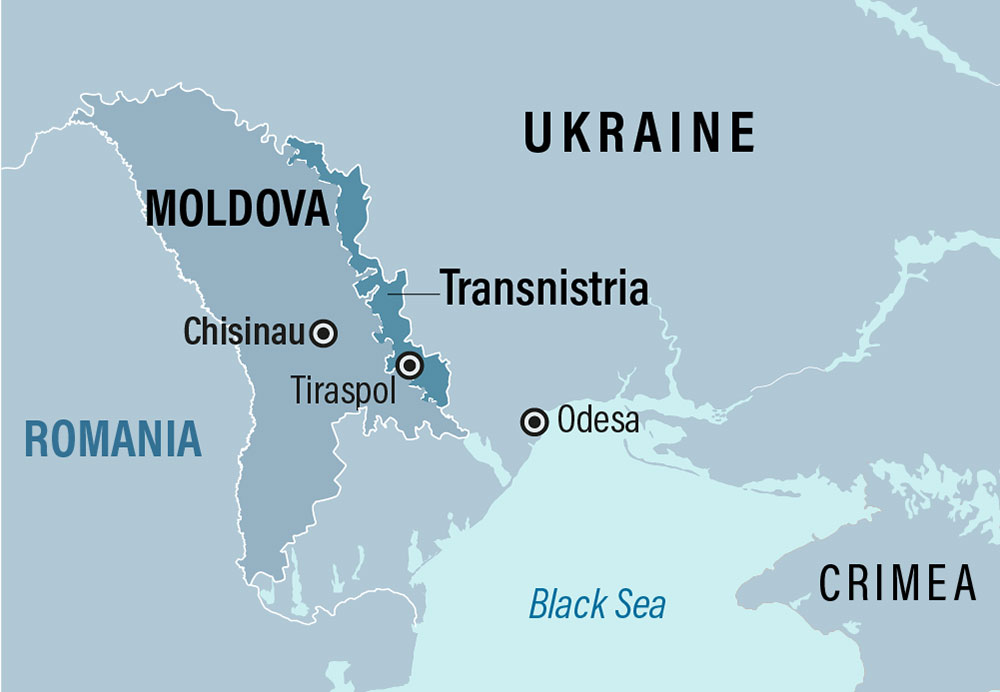
At the moment, the final victory is a matter of today and priority, but it should be understood that even achieving the Ukrainian goals of reaching the territorial framework of 1991 is not the final stage of lasting security guarantees for Eastern Europe. In addition to the full integration of Ukraine into NATO, an important element in stopping the escalation of the Russian military threat in all its manifestations is the elimination of all possible spheres of influence in the region. In this vein, the preservation of the Russian military contingent on the territory of “Transnistria” threatens to maintain a constant threat that can provoke destabilizing processes within Moldova, as well as restraining the country from further economic and political rapprochement with the EU.
Ukraine has already warned the leadership of Moldova about the plans and possible actions of the Russian side aimed at overthrowing the constitutional order and drawing “Transnistria” into hostilities against the Ukrainian side. Official Chisinau should remember all sorts of risks when planning its policy in the “Transnistrian” direction. After all, the scenario of an “explosion” of the situation in Moldova will always remain on the table of the military-political leadership of the Russian Federation.
It is important to understand that destabilizing actions can vary in nature depending on the circumstances. In the event of defeats on the southern front, the Russians may try once again at any cost to activate the “Transnistria” option to distract Ukrainian troops, or carry out a terrorist attack on ammunition depots in Kolbasna, realizing that in the event of the loss of the south of Ukraine and Crimea, they will lose all positions and in Moldova.
In any case, complete security of the Moldovan State, further integration into the EU – all this is possible only if the “Transnistrian issue” is resolved. Despite the blocking of all negotiation initiatives and other circumstances, in modern realities optimal conditions may arise for achieving a seemingly incredible goal. “Transnistria” can be integrated on mutually beneficial terms and several factors can speed up this process.
Foreign policy.
1) Successes of Ukraine in the southern direction.
Even before the liberation of Kherson, the ranks of the military-political leadership of the Russian Federation abstractly declared their desire to occupy the Odessa region and create a land corridor to “Transnistria”. After an effective operation to oust the Russian occupiers from Kherson, the prospects for an attack by the Russian army in the Odessa direction have significantly decreased, but soon they can confidently drop to zero.
In the event of a “breakthrough” by Ukrainian troops of the layered defense in the south, the complete liberation of the Zaporizhia and Kherson regions and reaching the borders of the Crimean Peninsula, all plans for the capture of Odessa and a corridor to “Transnistria” will prove completely impossible. There is no talk of landing troops, since this would turn into the extermination of one’s own armed forces. The only opportunity for the Russian side to shell the city’s infrastructure until Ukraine is able to strengthen its air defense system with the support of its allies;
2) Strengthening air defense in southern Ukraine.
In connection with the intensification of shelling of the Odessa and Nikolaev port infrastructure, Ukraine will raise with NATO countries the issue of the need to supply additional air defense systems. A critically important point is to secure the south of the country from constant air attacks so that the level of missile destruction reaches 100%, as we see in the example of Kyiv.
What could be of additional interest for Moldova here? Even if the Russian Federation wants to raise the “degree of confrontation” and draw Moldova into hostilities by launching strikes from the Black Sea on Moldovan territory, an improved air defense system on Ukrainian territory can become an effective deterrent.
3) Constructive position of the EU and the USA.
The approach of Western partners should be based on the principle “the settlement of the Transnistrian issue is an important opportunity to strengthen regional stability, and not the crossing of a conditional “red line” in the confrontation with the Russian Federation.”
Everyone understands that the conduct of the United States and other key NATO representatives in relation to the Russian-Ukrainian war is based on the provision “the war should not go beyond Ukrainian territory, should not go into the stage of direct conflict between Russia and the Alliance, and nuclear escalation is not allowed.” This approach “tied the hands” of the allies and forced them to delay making many important decisions regarding the supply of a certain range of weapons. But what has practice shown? The delivery of Himars did not provoke Russia into nuclear escalation, nor did the liberation of its territories by Ukraine, or the creation of a tank coalition, the supply of long-range missiles by France and Britain, or the rapid transfer of F-16 fighters.
The Russian side had no other options other than to “accept” these circumstances, since the Kremlin itself did not want direct confrontation with NATO and was afraid to use nuclear weapons, since this would alienate even loyal countries from them. Due to the lack of real military capabilities to hold “Transnistria”, the Russian Federation will not be able to fully resist the loss of political influence over the enclave.
If the EU and the US understand that the voluntary reintegration of “Transnistria” is a chance to reduce Russian influence without the threat of uncontrolled escalation, the issue can be technically resolved.
Internal political.
- Readiness of Chisinau.
The readiness of official Chisinau to take advantage of the opportunity, to form potential frames for the resumption of the negotiation process and compromise conditions for the reintegration of “Transnistria”.
- Readiness of Tiraspol.
Representatives of “Transnistria” must realize that even a nominal position on the political agenda and under the influence of the Russian Federation poses a constant threat. Direct support for war is a direct path to the destruction of one’s own population and complete political nullification, an attempt to “sit on two chairs” – reduces the time frame of the existing window of opportunity – if now it is possible to negotiate on compromise terms, then after the further loss of the Russian Federation its positions (especially in battlefield) – to remain in total isolation.
Conclusions.
After the events in Ukraine, no one is interested in escalating the situation and bringing war into their own home. In this regard, the military reintegration of “Transnistria” does not look like an attractive scenario, even if the entire operation would take a matter of days with Ukrainian support.
The priority is peaceful reintegration based on the political will and economic feasibility of both sides with the support and guarantees of international partners. The prerequisites for such a scenario will be created if the above factors are successfully implemented and the “window of opportunity” will be open.
In the information space, at the diplomatic and political level, the format of security guarantees for Ukraine is constantly being discussed, but a constructive approach would be to provide guarantees for Moldova, if the country is ready to take decisive political steps on the issue of reintegration of Transnistria. These guarantees must include both a military-political and energy component.
In any case, Ukraine’s victory in the war is a historical chance for Moldova, which the country needs to take advantage of.