
In the last two years, scandals related to the actions of Russian nationalist groups united under the common name “Russian Community” have become more frequent in Russia. Groups of people in civilian and sometimes military uniforms, armed with weapons and special chevrons, break into nightclubs with “raids”, attack and torture bloggers and journalists, break into the apartments of representatives of non-Slavic peoples or publicly force them to apologize for something under the threat of violence. In some cities, especially in the North Caucasus region, nationalist marches took place.
In the spring of 2025, the Orthodox priest Gabriel publicly called Muslims of Russia potential enemies and murderers. The “Chechen Kremlin stooge” Apti Alaudinov reacted emotionally to this speech, but after a meeting with representatives of the Russian communities (“Forty forties”) and Gavriil, he was forced to make a public conciliatory statement, talking about finding a consensus in ideas and views. Since then, he has been quite actively and publicly promoting a postmodernist version that combines an incompatible, but very familiar to post-colonial researchers phenomenon – mankurtism, or simply the voice of a representative of a non-Slavic people assimilated by the empire, calling themselves Russian (“more Russian than the Russians themselves”). The same became the symbolism of the Chechen military unit “Akhmat”, which in 2025 took the form of a centaur, combining an Orthodox cross with an Islamic crescent. It would seem that another wave of interethnic conflict, breaking through with alarming regularity to the public surface of Russian society, was once again cut short by a shout from the Kremlin, forcing the ideological opponents to reconcile. But once again, another confrontation between Russian national chauvinists and representatives of the Caucasus spilled into the public arena. In June 2025, representatives of the “Russian Community”, with their faces covered, attempted to kidnap two Chechen children in the Moscow region city of Lyublino, where the Chechen community lives compactly. Judging by the video footage filmed by the nationalists, they accosted two teenagers aged 8 and 11, a brother and sister, who were dancing the lezginka in the courtyard of a house and, after arguing with them, attempted to kidnap them, but were stopped by local residents. The police were unable to detain them, citing the fact that they allegedly had “documents from the Investigative Committee of the Russian Federation,” which suggests that this movement is covered by law enforcement agencies (under the patronage of Bastrykin). However, the nationalists carry out raids on clubs together with the police, so their cooperation is no secret.
The situation has caused a wave of indignation both from the authorities of Chechnya and some other non-Slavic regions of Russia, and it has not been resolved to this day. The authorities of Chechnya are expressing dissatisfaction with the situation, and individual Chechen fighters are calling in representatives of the community for talks in the presence of the police.
It seems that the growth of interethnic tension caused by the excessive activity of Russian nationalists controlled by the Kremlin is obviously increasing the degree of internal conflict in Russian society. But why does the Kremlin need this? To answer this question, we must first understand what the Russian community is. The Russian national movement in its radical national-chauvinistic and racist forms arose in the late 1980s, on the eve of the collapse of the USSR. In 1990, the organization Russian National Unity was officially founded, combining the ideology of a special form of Orthodox nationalism, chauvinism, Islamophobia and fascism under the leadership of ideologist Alexander Barkashov. In many ways, it repeated the ideas and slogans of the radical movement of the Black Hundreds of the late Russian Empire, and therefore for its supporters and ideologists, the imperial period of Russia is an example to follow. RNE actively supported the actions of the federal center during the Chechen wars. Until 2000, RNE existed as a more or less unified whole, combining the ideas of the Russian nationalist political movement. After the split and disagreement with some of the founders, the organization was divided into different movements, but the main cell of RNE survived and exists to this day. Since 2014, the majority of RNE supporters have been participating in the war in Ukraine and recruiting volunteers to join their ranks.
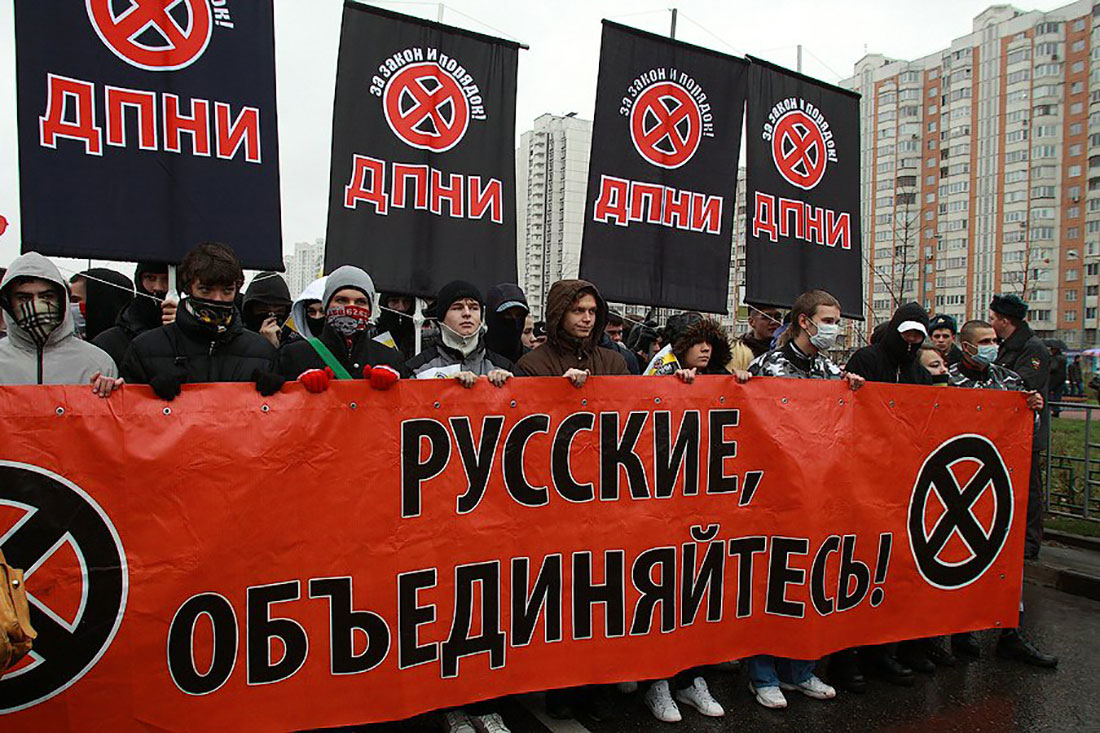
Against the backdrop of the split and decline in the activity of the RNE in the 2000s, the vacuum of radical nationalism was filled by another organization that emerged in 2002 after a spontaneous interethnic conflict in the city of Krasnoarmeysk in the Moscow region. The “Movement Against Illegal Immigration” (DPNI) emerged as a voluntary association to combat illegal emigration, but with a less radical agenda. DPNI preferred to act within the legal framework, but quickly grew into a political movement. However, the RNE was also a political movement and even created a party that was banned in the elections of the late 1990s. Moreover, both organizations were initially opposed to the authorities in any of their manifestations, considering Moscow to be insufficiently respectful of the national interests of the Russian majority. In the 2000s, the political game acquired a different shade and was perceived by the authorities more cautiously. The DPNI, led by Alexander Belov (Potkin), began to unite supporters of various political movements, organized “Russian runs” and sports events, following the fascist paradigm of “health of the nation”, this movement had its own musicians, one of whom we will talk about below. The growth of popularity of Russian skinheads, which became a large-scale youth phenomenon in the country in the 2000s, is also associated with this movement. Future politicians spoke at anti-government rallies and demonstrations, including Alexei Navalny, who was reminded of his connections with Russian nationalists for the rest of his life. Public ideology and calls to fight “non-Russians” led to an increase in interethnic conflicts, as happened, for example, in Kondopoga in 2006, where pogroms lasted for several days. The last straw for the authorities were the riots on Manezhnaya Square in Moscow from 2010 to 2011, which were based on nationalist, migrant-phobic and Caucasian-phobic statements and calls of DPNI supporters. The authorities’ reaction to these mass riots was very harsh. As a result, in April 2011, the movement was recognized as extremist by the Moscow City Court.
In the same year, the organizers of DPNI created a new organization, “Russians”, which logically continued their activities until 2015, when it was also recognized as extremist and dissolved. In content, it was the same organization, with the same political goals and ambitions, headed by politician Dmitry Demushkin.
Thus, the era of opposition and politicized movements of Russian nationalists in Russia ended. Some of them were carried away by the ideas of the “struggle for Novorossiya” in Ukraine, where they took either a neutral or allied position with the Kremlin. The other part was suppressed by the authorities – squeezed out of the country (partially united in the RDC in Ukraine), destroyed, or imprisoned for long terms. The peculiarity of all these movements was their opposition to the authorities, the desire for political registration and consolidation in state structures as an independent force. However, the elimination of political competition did not lead to a decrease in the demand for nationalist and racist ideas in society, especially such a chauvinistic and xenophobic one as Russian. The Kremlin understood this and therefore quickly took the rhetoric and narrative of Russian nationalism under its control. At the end of 2020, against the backdrop of large-scale and harsh actions of the official authorities aimed at combating illegal migration, an informal association, the NGO “Russian Community”, appeared in the public sphere for the first time. Its founders are considered to be Yevgeny Chesnokov, Andrey Afanasyev and Andrey Tkachuk – journalists and regional politicians of the Orthodox radical persuasion. The first two, as the main organizers, prefer to remain in the background. They are credited with close cooperation and patronage of the Orthodox oligarch Malofeev, an influential ideologist of modern Russian political life. However, the very idea of the community arose on the basis of the Covid-dissident movement of Andrei Tkachuk, who remains the informal leader of the association to this day.
After a lull in 2021-2022, the organization emerged from the shadows in 2023 with the tacit support of the head of the Investigative Committee of the Russian Federation, Alexander Bastrykin, known for his migrant-phobic and Islamophobic views and public radical statements. From that moment on, branches and cells of the organization began to appear in all regions of the Russian Federation, especially in the Caucasus. And although from the very beginning the organization positions itself as acting exclusively against migrants and within the legal framework, the actions of its supporters show that they equally perceive the indigenous peoples of Russia of non-Slavic origin, especially Muslims, as their enemies. The Russian community relies on the support of the authorities and often goes beyond the limits of what is permitted by law, although not to the same extent as was the case with Russian nationalists in the 90s and 2000s. Apparently, most of the actions of the Russian community are carried out in agreement with the official authorities and under their control, that is, this activity is more reminiscent of the Black Hundreds of the era of Nicholas II than of Russian nationalists of past years.
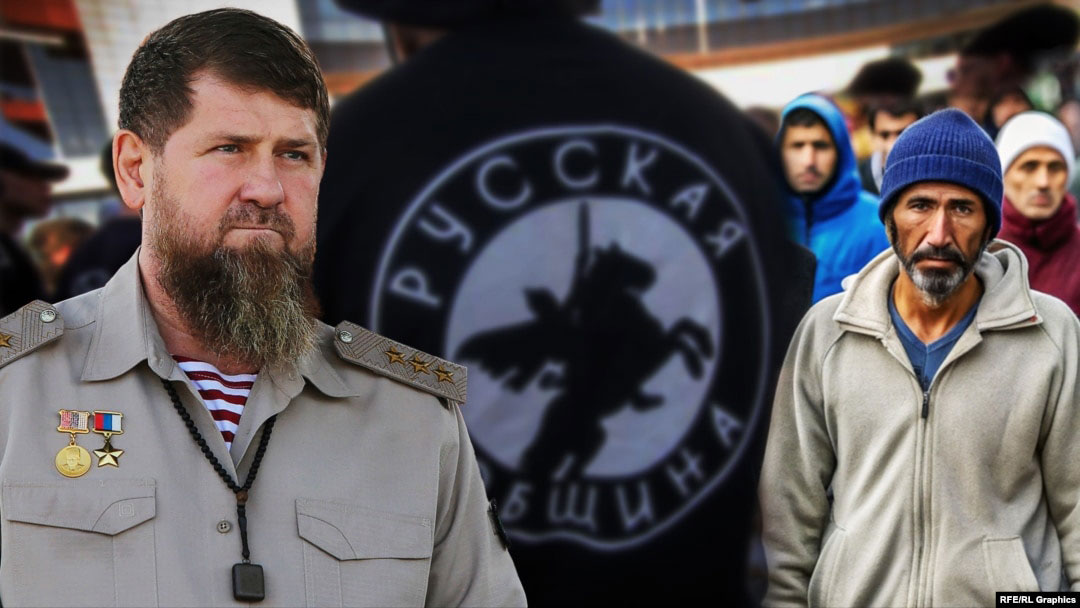
This is also supported by the unification of efforts of nationalist organizations created in recent years. These are the scandalous “Forty Forties” (radical Orthodox activists, supporters of the “Male State” and Covid dissidents led by businessman Andrei Kormukhin since 2013) and the right-wing radical movement “Northern Man”, created by the nationalist rapper Misha Mavashi, the same one who gained popularity during the years of the existence of the DPNI and “Russians”, but went over completely to the side of the Kremlin and the FSB. Mavashi is more focused on volunteering in the war zone in Ukraine and supporting radical nationalist battalions, like “Espanyola”. Thus, with the administrative support of the Kremlin, over the past 3 years in Russia a huge network of more than 150 cells of the “Russian Community” has grown, operating most often autonomously, but according to the general methodology of the Kremlin, having many supporters. Unlike all previous movements of Russian nationalists, the new movements are completely pro-government and were created to channel xenophobic sentiments of society. On the one hand, this looks less serious and dangerous, but on the other hand, it shows where the interethnic and interfaith policy of the Kremlin is heading in general. The problem of the Kremlin’s interception of the Russian nationalist agenda is that in the conditions of war and unprofessionalism, as well as the generally rabid chauvinism of some oligarchs and the elite, the actions of structures controlled by the authorities only lead to increased tension and conflict in the country. A particularly serious threat is seen in the clash of ideas of Chechen and Russian nationalisms, equally important for Moscow. In an attempt to resolve them, the federal authorities are clearly striving to synchronize and harmonize these types of nationalism through constant moderation of conflicts between Chechens (and Muslims more broadly) and Russian nationalists. The Kremlin is using them against each other to contain their ambitions, a classic “divide and rule” policy. For this, Moscow is using Apti Alaudinov as the main person who is obliged to negotiate the resolution of all possible conflicts. Considering the role of the Kremlin’s protégé in Chechnya after Kadyrov’s replacement, which the federal authorities are counting on, Alaudinov is seen as the person who will have to keep the precarious situation of conflicting views and ideas of Russian nationalists and non-Slavic peoples in a direction acceptable to the federal center. The level of attention paid to Alaudinov to the detriment of Kadyrov makes this desire of the center and its plans for the future of Chechnya clear. Will this strategy be successful or will we see its failure with a subsequent increase in conflicts on interethnic grounds – the near future will show. Already now, statistics from the Russian Interior Ministry and the Sova monitoring center show an increase in the number of attacks on people from Central Asia and the Caucasus, as well as attacks on “ideological opponents” of nationalists. The Russian Interior Ministry notes an increase in “ethnic incidents” by a quarter in 2024. In 2025, a special scandal occurred in Moscow, when a particularly ardent activist of the “Russian Community” at the airport tried to forcibly detain a woman from Buryatia, who seemed to him to be a migrant from Central Asia. The situation led to a loud scandal and the involvement of the Buryatia authorities in the situation. However, all attempts by local authorities and even influential Chechen representatives in the Kremlin to appeal to government agencies for investigations were unsuccessful, which indicates a very high degree of patronage over the movement on the part of the country’s top leadership.
Now it is clear that the genie of Russian nationalism has been released at the most difficult moment for Russia, when a potential regime change could lead to a loss of control over the situation. We will likely see both sides fighting for this resource in future political storms.