
Anton Naichuk, Ph.D, the head of East European Council
Parliamentary elections in France demonstrated the remarkable political skill of the French President: you can win even if your party is in second place.
It is worth noting that after the hard defeat during the vote for the European Parliament and the lowering of Macron’s ratings, there were no best scenarios left for him. However, out of all the bad options, he chose the most acceptable one and did not lose. Thanks to “sensible voting in French” – when in the second round of elections representatives of all political forces acted as a situational alliance and nominated one candidate against the right-wing radical – Marine Le Pen’s party will not form a parliamentary majority.
Technically, the French electoral system helped: after the first round in each district, the favorites are determined, between which the voters choose in the second round. In those constituencies where, for example, there were strong candidates from the “Macronists” and “left”, one of them withdrew his candidacy and called to vote against the representative of the “National Union”.
As a result, the elections, which were supposed to indicate the expression of the French people’s mandate of no confidence in the President and his party, became a union of the French against the right-wing radicals.
What’s next?
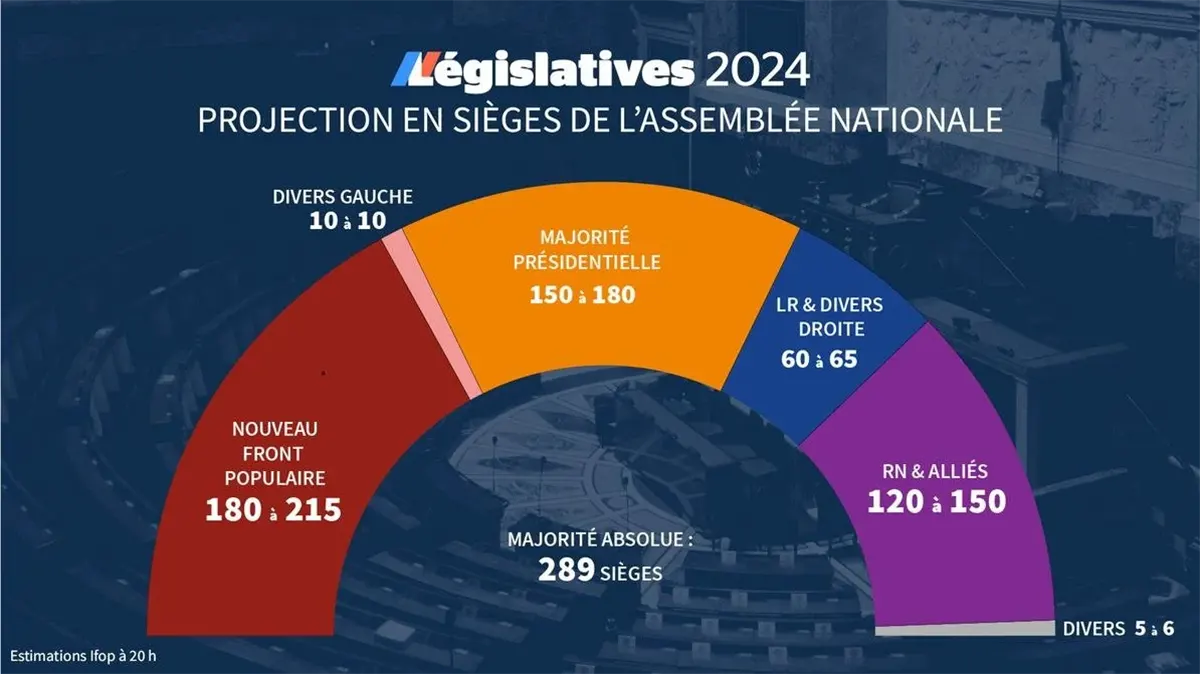
The victory was won by the “New People`s Front” – 182 seats in the Parliament, which is a symbiosis of left and left-centered forces, including communists, greens and other groups. From the point of view of Ukrainian interests, the leader of “Unconquered France” Jean-Luc Mélenchon appears to be the most dangerous member of the alliance. He often resorts to rhetoric that fits into Russian propaganda strains.
From now on, the United Socialists should lead the negotiation process regarding the formation of a coalition.
The party of the President “Together” will act as a full member of such consultations. It is important that they got an excellent result – 168 places: if a few days ago they were expected to take the third position, a solid second position was actually a victory for them, taking into account the difficult circumstances.
With this level of support, “Together” gained more subjectivity in conducting negotiations. The first signs of such confidence were demonstrated by the leader of “Together” Stephane Sejournay, who noted that the police force is ready for talks, but on the condition that Jean-Luc Mélenchon is excluded from it.
In any case, it can be concluded that the right-wing radicals have lost and are unable to create a majority. Their future prospects are uncertain.
Theoretically, the “Macronists” are able to form a coalition with the united left, but the President’s party will have to make serious concessions in matters of economic and social policy, the parties will have to write a coalition agreement, and the potential new majority, like the Government, will be quite shaky.
However, such a scenario is acceptable for Emmanuel Macron – as President, he will be able to act from leadership positions and lead his political line in the future. The situational union of a politically strong President and a weak Government will allow Emmanuel Macron to effectively use his powers to “keep afloat” until the end of his term.
Undoubtedly, this is good news for the Ukrainian people. Despite a certain political crisis in France, the President manages to get out of a difficult situation, which means to maintain the course of political support for Ukraine.
Old new Government
It is interesting that another course of action has appeared in Emmanuel Macron’s political arsenal. Given the severe fragmentation of the new Parliament, negotiations on the majority may be significantly delayed. A similar precedent has already taken place in the Netherlands.
According to the legislation, if the parties are unable to form a coalition, the next dissolution of the Parliament can be carried out only after a year – that is, in June 2025.
Until the parties reach an agreement, the country will have an interim government, and here is an important point: although the current Prime Minister Gabriel Atal has resigned, theoretically he can remain in office until the National Assembly reaches an agreement on the formation of a parliamentary majority.
Thus, while the negotiations are ongoing, Emmanuel Macron can keep the Government previously approved by him. In such circumstances, the “Together” party will have no reason to rush into consultations about the majority with the “New People`s Front”.