
Pavlo Klimkin: “it is in the interests of China to have a weakened Russia, not the one that wins or receives advantages”
The Russian-Ukrainian war reduced to a constant search for allies. Initially, this task faced only Ukraine. However, the defeats on the battlefield provoked the Russians to take such actions, which are now actively conducting negotiations with all those who cannot be called a “member of the Western world.”
The next round of such negotiations took place on March 20-22 in Moscow, during the meeting between Putin and the President of the People’s Republic of China, Xi Jinping. We talk about the already existing consequences of this visit, as well as its impact on the future, with the former Minister of Foreign Affairs of Ukraine (in 2014-2019) Pavlo Klimkin.
We begin the conversation with the level of subjectivity of the Russian president, since many experts do not believe that he still remains an equal partner in Russian-Chinese relations. However, Pavlo Klimkin notes that it is still too early to talk about Vladimir Putin’s vassalage:
He still has not become a vassal in the classical sense. But their partnership is asymmetric in the technological, economic, and increasingly in the security sense. The economy and population of these states differ by a factor of 1 to 10. So, it is clear who can dictate the terms. In this sense, Russia is heading towards vassalage. But as for the provision of security guarantees for Putin, this conversation is not about China.
With its trade, China provided Russia with the possibility of survival, so it actually saves Putin’s regime, but not in the sense of security guarantees. Russia is a nuclear power and does not need additional guarantees.
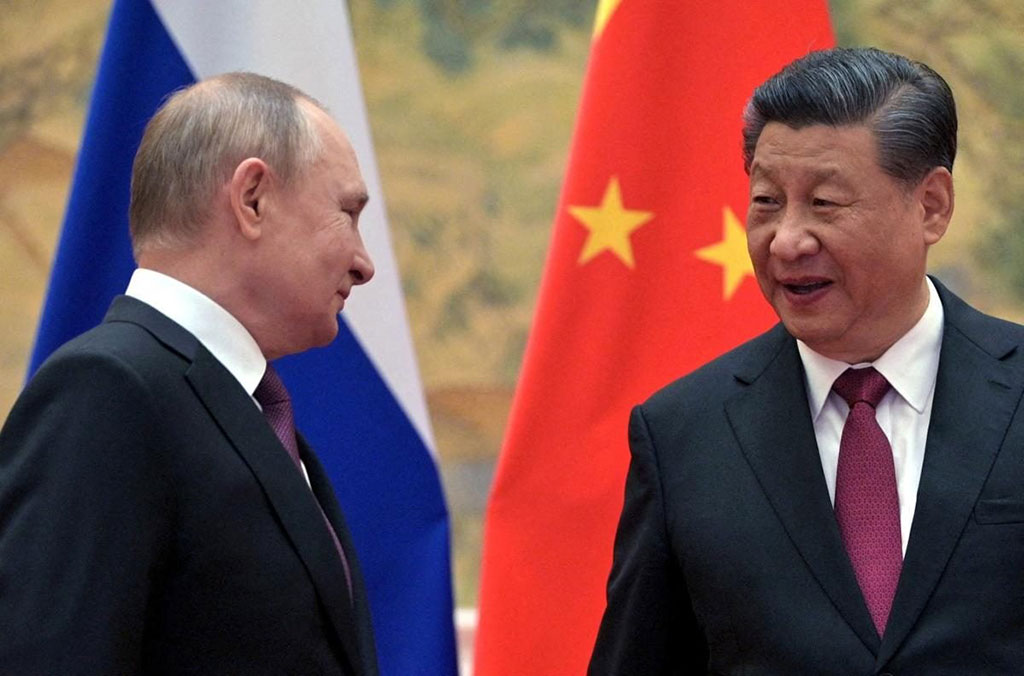
During the negotiations in Moscow, the leaders of the states signed the “joint statement of the President of the Russian Federation and the President of the People’s Republic of China on the plan for the development of key areas of Russian-Chinese economic cooperation until 2030.” What does this document mean?
The Chinese really need projects in Russia. Participation in the development of resources and their transportation. They want to have a stake in these campaigns and ensure a long-term supply of resources. They are also interested in transit opportunities – from Europe to China and vice versa. That is why these agreements are very important. However, China wants them to be concluded on the most favorable terms for it, and not on the basis of an equal partnership. Therefore, they will bargain to get the most favorable conditions for themselves.
What does China need first of all in this relationship?
As I already mentioned, the first thing is resources. But not only oil and gas, but also everything that goes to China. The second is transit opportunities. Both existing and new ones that will go not only in the concept of the Silk Road, but also with the use of the Northern Sea Route. The third is technological capabilities: civil, military and dual-directional, since some technologies still remain in Russia. Although there are fewer and fewer of them, the volume of what can be taken from Russia is constantly decreasing for China. But sweeping away what is there is a very important strategic task for them. I think it will happen in a few years. And in 5-7 years, as many experts tell me, there will be nothing for the Chinese in Russia.
Can we assume that after this the Russian Federation will not be interesting to them?
No, she will not become uninteresting for them. This will not happen, precisely because Russian resources will be used by the Celestial Empire for decades. Also, transit opportunities and a certain limit of Russia’s stability are important for China.
In the course of the conversation, we also touch on an urgent issue for Ukraine – military support of the Russian Federation. We are talking about this in the context of the so-called leak of data from the Pentagon, which indicated that at the beginning of the year, the PRC refused to provide weapons to “Wagner”.
– It is difficult to comment on these showers, since no one knows how authentic they are – says Pavlo Klimkin. – But the topic of arms supply was 100% present at the negotiations in Moscow. And not only between Putin and Xi Jinping. Chinese Defense Minister Chang Wanquan was recently in the Russian capital. But as we can see, there is currently no evidence of Chinese arms supplies. And I believe that China is not interested in its shipments. After all, they understand the price of this issue. Moreover, it is in their interests to have a weakened Russia, not one that wins or benefits. However, this does not mean that there are no smuggling schemes or the supply of dual-purpose goods, microchips and many other things used in the Russian military industry.
Can the results of the Chinese minister’s visit be such that we should be afraid?
Don’t be afraid. But consider – yes. This is a story about coordination of defense policy, exchange of information and experience, joint exercises. It is worth understanding that the Chinese are following our war in real time and drawing conclusions from it. Therefore, although there is no need to be afraid, we see how the military cooperation between Russia and China is developing. Not in the sense of supplying weapons, but coordination. respond to rate hikes, escalations.
At the same time, Putin is trying to “jump out” of their agreements. For example, in March, the heads of state signed a statement on the impossibility of the proliferation of nuclear weapons, and in a few days, the Kremlin will make a decision on the placement of tactical nuclear weapons in Belarus. Therefore, there are also very difficult moments in this cooperation. And in the future there will be more and more of them.
Returning to the meeting of the presidents, nuclear blackmail of Ukraine and the West began almost immediately after Xi Jinping’s departure home. Doesn’t this mean that the authoritarian leaders agreed on something?
No. I don’t think they reached any agreement. Moreover, when the President of the People’s Republic of China received Alexander Lukashenko in Beijing on March 1, he showed that without the participation of the so-called President of the Republic of Belarus, it is impossible to make any key decisions regarding this country. I believe that the decision on Belarus was critically necessary for Putin, as it is part of his strategy of nuclear blackmail, which psychologically affects the West. Although limited, this is the only real leverage that the Russian president has with regard to the West. And he will continue to promote it with various exercises, the placement of nuclear weapons in Belarus, or similar threats.
The ex-minister also adds that Oleksandr Lukashenko also has his weight in the eyes of Beijing:
China perceives him as a de facto leader. It is clear that it is not profitable for them to give Belarus one hundred percent into the hands of Putin. Actually, with his invitation to Beijing, Xi Jinping largely created support for Lukashenka, and in a sense, even saved him. I am absolutely sure that Russia will continue to create opportunities for complex influence on the Belarusian leader, as well as depriving him of real leverage. However, so far they cannot replace Lukashenko without risks. And inviting him to Beijing, the President of the People’s Republic of China said: “decisions regarding Belarus must be discussed with us. After all, the European security architecture, modern and future, is also important for us.” Putin perfectly understands this red line.
At the same time, I do not believe that this topic did not come up during the talks between Putin and Xi Jinping, or at another level. For the Chinese, this topic is very difficult, because it could lead to nuclear proliferation. And all the countries around China are technologically, financially, and in terms of human potential capable of developing atomic bombs. That’s why China doesn’t want it. There they understand that once the “nuclear genie” is out of the bottle, it is impossible to put it back. Therefore, China does not like Putin’s decision in any case. And this is what all their experts say.
After repeated threats in our direction, the Ministry of Foreign Affairs of the People’s Republic of China issued a statement with a rather ambiguous text. It stated that “wars between states possessing nuclear weapons should be avoided and strategic risks should be reduced.” But one of the parties may not own it…
In fact, this is China’s standard position. They have always said that nuclear weapons exist only for deterrence and cannot be used. The Chinese have never deviated from this position and I do not think that it is necessary to look for a triple bottom in the statement about the impossibility of wars specifically between nuclear countries. It’s just that China once again emphasized the impossibility of a nuclear conflict. There is nothing deeper in the statement.
Does China have the leverage to force the Russian elite into submission if its actions violate Chinese interests too much?
Yes, but not absolute. His methods of influence are also relative, and China cannot order Putin to do anything. Their mutual relations are the relations of junior and senior partners, which in the economic sense acquire vassal characteristics. But I do not see that Beijing can order anything to the Kremlin.
However, while the world is being threatened with an atomic bomb, it is necessary to fight against it. In the domestic information space, the opinion immediately appeared that it would quickly end with our accession to NATO. So we ask Pavel Klimkin about it.
Ukraine has very high hopes for the July summit in Vilnius. Is there any chance that nuclear blackmail will finally be stopped there?
NATO will work on new methods of deterrence, and Russian threats will contribute to this. This is absolutely obvious. But whether appropriate decisions will be made regarding our membership in the alliance is important, but not critical. In the sense of Ukrainian hopes, yes – it would be important for us to see them already during the meeting in Lithuania. However, if this does not happen – in 2024 there will be a very important summit in the USA. And I’m not a fan of getting attached to such events, when important decisions are made in such a semi-celebratory atmosphere. Sometimes it is better to accept them under the conditions of a friendly and trusting dialogue. Therefore, the summit in Vilnius is important, but if there is nothing significant for Ukraine, it does not mean that it will not happen in a different format.
NATO Secretary General Jens Stoltenberg came to Kyiv the other day, and once again emphasized that we should be part of the North Atlantic Alliance. Could this indicate an already made decision to accept?
I am absolutely sure that the decision on Ukraine’s membership in NATO is gradually coming to mind and becoming acceptable to other countries, but there is still no consensus on this issue. Secondly, the logic of how and under what conditions we will enter there is more important for us. That is, strategic clarity is necessary, because we were told that Ukraine would become a member of the alliance back in 2008.
It’s like in the conversation from “Alice in Wonderland”, when she asked the Cheshire cat “where should I go?”, and he answered: “and where do you want to go?”. Now we understand where we want to go. Now we are determining which way we will go to achieve this. And this is part of the general review of NATO’s strategy and their understanding of the conditions in which we and they find ourselves.
Can we get there immediately after winning the war?
This also requires a consensus on the part of the members of the military-political bloc. And among the allies there are different opinions. Therefore, our argument should be based not on what they can give Ukraine, but on how our membership will improve the overall security situation for allies.