Anton Naichuk, Ph.D, the head of East European Council
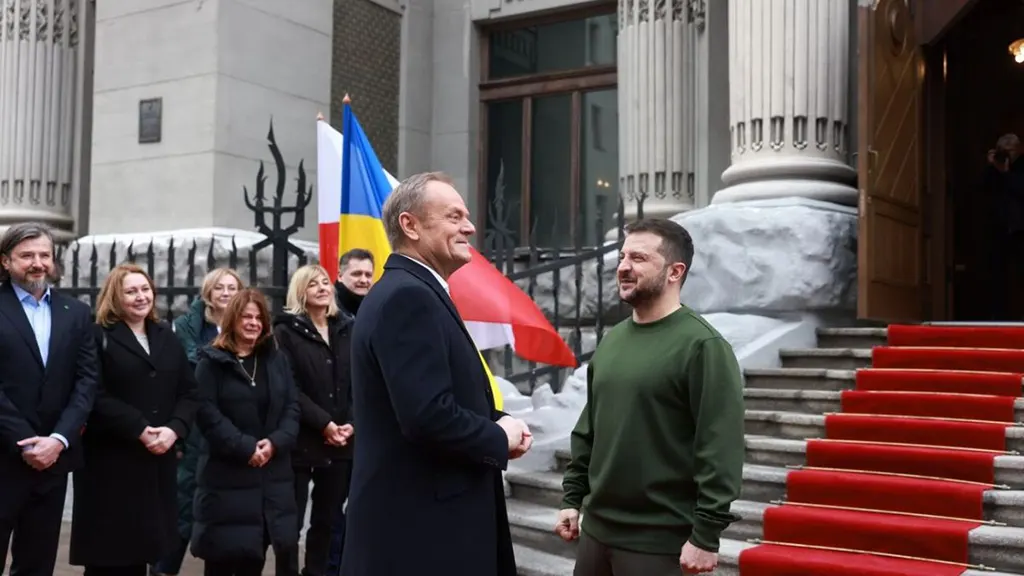
Last week was important for the development of relations between Ukraine and Poland. Prime Minister Donald Tusk’s visit to Kyiv was accompanied by many expectations and hopes. After a difficult period in relations between the previous “Law and Justice” Government and the Ukrainian leadership, Donald Tusk’s coming to power gave many observers reason to count on a “reset” and settlement of all existing contradictions. Both sides have made a good start for the future, but the ability of the officials of Kyiv and Warsaw to make quick and easy decisions should not be overestimated.
The first contact at the highest level suggests that further relations between the countries should be conventionally divided into two tracks: political-security and economic.
The first one has significant prospects and limited risks. It consists in Poland’s readiness to provide comprehensive assistance to Ukraine in confronting Russian aggression and protecting the eastern borders of Europe.
Donald Tusk made a notable gesture of support for the Peace Formula of Ukraine: Poland will join the Resolution of the G7 countries on security guarantees. Such a move means the likely start of negotiations on a comprehensive agreement that will determine the direction of cooperation between the countries in the field of the military-industrial complex. In addition, the Polish Prime Minister announced the provision of a new military package, the first since huge volumes of military equipment and ammunition from Poland were suspended due to the start of the infamous summer-autumn conflict in 2023.
There is no doubt about Poland’s readiness to be an active participant in the pro-Ukrainian international coalition.
The second is a complex interweaving of diverse interests, where it is difficult to draw a compromise line. There were no specific strategic statements regarding the understanding of the export of Ukrainian agricultural products or the final solution to the problem of carriers.
Of course, Donald Tusk made a great political move when he managed to agree on the suspension of the protests of Polish citizens at the checkpoints, unblocking them on the eve of his arrival in Kyiv. However, the situation remains uncertain. In Ukraine they say that they have done everything possible on their part, but in Poland they hint that the further development of events on the borders will depend on the decisions of the Ukrainian authorities.
There are even more difficulties in the issue of exporting Ukrainian agricultural products. Against the background of Donald Tusk’s restraint, Minister of Agrarian Policy Cheslav Sekerskyi and Vice-Minister, leader of “Agrounia” Michal Kolodziejczak make rather provocative statements about the need for indefinite restrictions on Ukrainian agricultural products or their ban for 20 years.
It looks like a game of “good-bad cop”, when radical agrarians from the Government of Poland take the most extreme positions, Donald Tusk, within a constructive framework, is looking for approaches to understanding with Ukrainian colleagues or trying to get preferences at the EU level. With a high probability, in the field of dialogue with official Brussels, the Polish Prime Minister managed to achieve certain results, because in the near future the European Commission may develop special restraining mechanisms that will provide for the possibility of imposing restrictions on certain Ukrainian export positions, if they create risks of overfilling the Polish market.
One gets the impression that Donald Tusk’s Government has clearly defined a line of behavior in the Ukrainian direction: integrity and activity in the matter of political and security support and protectionist pragmatism in the economic sphere.
It should not be expected that Donald Tusk will make significant concessions regarding the “border and grain” on the eve of local elections in Poland and elections to the European Parliament, as well as during a tough confrontation with the opposition – the “Confederation” and, first of all, “Law and Justice” , who are ready to use every miscalculation of the new Government to destabilize the political situation.
If the statements of the Minister of Foreign Affairs Radoslav Sikorskyi and Prime Minister Donald Tusk about the need to support Ukraine, expand military aid and unblock financial receipts from the EU demonstrate full solidarity with official Kyiv, then the topic of bilateral economic relations continues to be a complex puzzle where both sides will have to work for more than one day to develop an acceptable formula.