
Associative expert of the East European Council, Vitalii Shtybin
The dramatic events unfolding in the Middle East have absorbed public attention. The large-scale Ukrainian conflict barely manages to stay within its horizon. Not to mention the periphery of attention in which the Caucasus finds itself, where the Karabakh confrontation still makes itself felt by the constant updating of the issues of transport unblocking of the Zangezur corridor and the geopolitical future of Armenia.
However, in this fog of war, global shifts continue, which will permanently change the contours of the relationship between various forces not only in the South, but also in the North and Central Caucasus. While the world is watching the big news, Russia is quietly, but very decisively, changing the status of Abkhazia with a sweep not only to the entire Western Caucasus region, but also to the vast Caucasian diaspora in the countries of the Middle East and Europe. And these processes did not begin yesterday.
UNION OF UNEQUAL RIGHTS
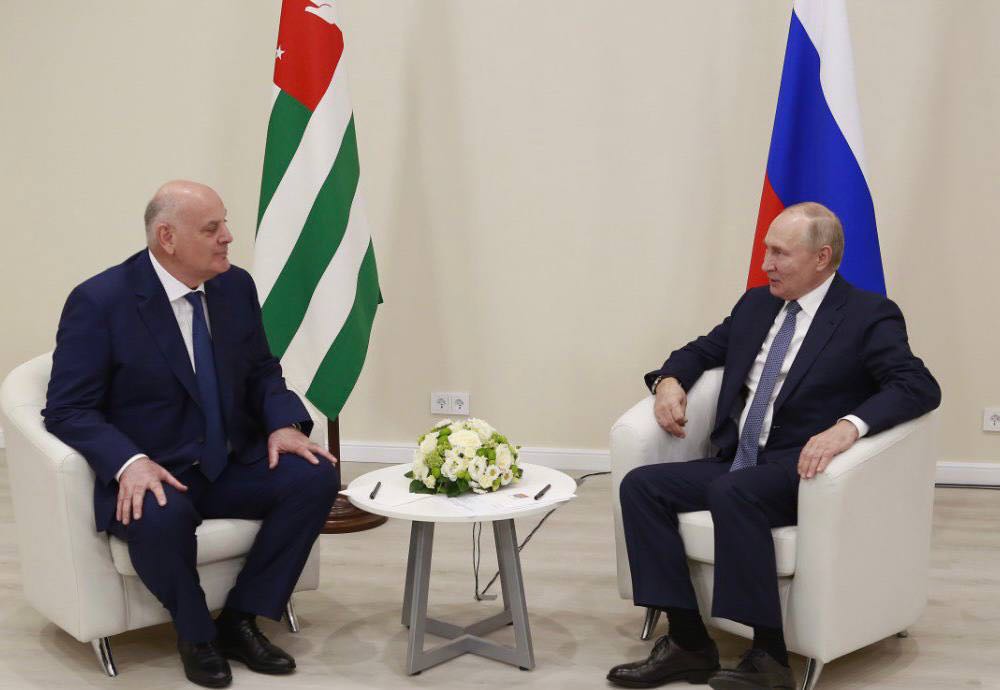
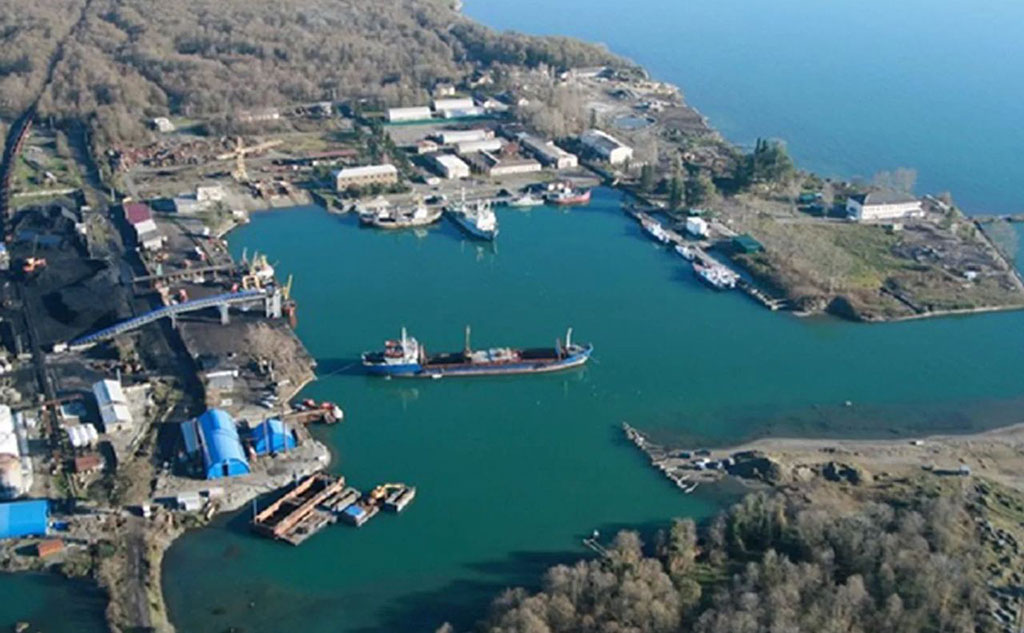
At the beginning of October 2023, the leader of the unrecognized republic, Aslan Bzhania, after negotiations with Vladimir Putin, announced big plans. Even before the meeting, various media outlets created an aura of grandiosity around it, as if as a result a decision would be made on Abkhazia’s entry into the Union State. The results of the meeting were more than modest. The parties limited themselves to a statement about the creation of a naval base of the Russian Black Sea Fleet in the bay of the village of Ochamchira. According to them, the construction project has already been signed.
The port infrastructure has existed in Ochamchira since Soviet times – since the 1940s, the base of patrol ships of the NKVD (KGB) of the USSR was stationed there, and later border patrol boats were based here. In the 1990s, only a boat repair base and part of the so-called Abkhazian navy remained in the port.
In 2009, after the Russian-Georgian war, the idea of creating a base for the Russian Black Sea Fleet in Ochamchiri was first expressed publicly. However, Russia then limited itself to only creating a coast guard post for its border service (FSB unit), which has since been stationed in the port. And now, in 2023, old projects will be publicly revived again. But how realistic are they?
The official rhetoric of the Abkhaz, and partly Russian authorities, links the construction of the Black Sea Fleet base with the need to protect the southern flank from possible threats emanating from NATO countries actively conducting various exercises in the Caucasus region. Political scientists also emphasize Russia’s desire to move the fleet to the safest possible distance from Ukrainian missiles and drones. This interpretation seems logical, but it misses several important points. Firstly, relations between Georgia and Russia today can be characterized as cautiously neutral. Violating them with such statements is at least unproductive. At the same time, as relevant experts say, the construction of the port will require 3-4 years, which at least contradicts the ideas about the security of the Black Sea Fleet even now, in the active phase of the war. As always, behind each statement you can notice numerous “protruding ears”.
On the one hand, we see elements of political bargaining. In February 2023, the Russian-Georgian Business Council was created in Russia at the Chamber of Commerce and Industry, which was headed by the vice-president of the National Fund for the Preservation of Cultural and Historical Heritage and the Development of Sustainable Tourism, Yuri Balashov, a systemic person. A month after its creation, the business council voiced the idea of restoring air traffic between Russia and Georgia, which was perceived negatively by Georgian public opinion. In turn, the Georgian authorities tried to work out certain conditions. In May, conversations became more frequent, but without much results, and in June, quite unexpectedly and quickly, several companies opened air services at once. Despite the furious reaction of the opposition public, it was not possible to change the airlines’ decisions. Resistance actions were limited to the picketing of several planes with tourists from Russia, after which they faded away and today air traffic between Georgia and Russia is developing on an increasingly large scale.
In September, the same business council dropped its second trial balloon. Statements by its participants about the “desire” to open a road through the Tskhinvali region (the so-called South Ossetia) and to build a railway from Russia to Turkey through Abkhazia appeared in the public sphere. Such statements caused a more unambiguous negative reaction, since assumptions about any recognition of independence in the decisions of the separatist regions in Georgia are perceived painfully both in society and within power structures trying to take a position of neutrality. In all likelihood, it was then that the bargaining began.
Even during the time of Mikheil Saakashvili, the Georgian authorities first expressed their intention to build a deep-water Black Sea port in Anaklia, next to the conditional border with the territories controlled by the Abkhaz authorities. On the one hand, it was supposed to give a powerful impetus to the development of the region, as an infrastructure and fuel hub from Asia to Europe. On the other hand, Anaklia was supposed to present Georgia to the rebellious Abkhazians in a better light, giving them the opportunity to think about returning to the fold of the Georgian state. The project came to naught with the departure of Saakashvili’s party. It was periodically revived in different years and started talking again in 2022. External investors were attracted to the project, including Chinese companies. China is already actively involved in massive infrastructure construction in the country. However, the Anaklia port project has been marred by corruption scandals, and news of the possible construction of a Russian naval base nearby has only further spooked investors.
The announcement of plans to build a Russian military base in Ochamchiri aroused the displeasure of Georgian parliamentarians, who demanded that the head of the security service, Grigol Liluashvili, present a report on possible threats, which he published in Parliament in mid-October 2023. Thus, in a classic way, repeatedly tested by Moscow in the past, the Russian authorities are trying to put pressure on Georgia, trying to force it to enter into negotiations with Abkhazia on equal terms, that is, to de jure recognize its subjectivity, for the sake of the project of unblocking communications that are vital for Russia with Turkey.
They are especially important for Moscow also because circumventing sanctions through Georgian territory has proven impossible in recent months. After the United States signed an agreement with Georgia on the deployment of its specialists on the main transport routes towards Russia with the right to make the final decision in determining the sanctionability of inspected cargo. The only direct route for Russia turned out to be the Abkhazian ports, the control of the arrival of cargo through Turkey cannot be controlled from the outside. But this route is limited by the low capacity of the Sukhumi port, despite new railway tracks specially built for this purpose.
GOLDEN SHORE FOR THE KREMLIN
On September 30, 2023, a large anniversary military parade dedicated to the 30-year victory in the Georgian-Abkhaz conflict took place in Sukhumi. With his scale and pathos, he seemed to be saying – a generation later, we are still not subordinate to Georgia, we have our own strength and desire to be independent. To once again emphasize this status, representatives of Russian troops from among the units represented in Abkhazia walked along the streets of Sukhumi along with Abkhazian equipment. However, in this seemingly cloudless union, long-standing cracks appeared almost immediately.
The parade and negotiations between the Abkhazian authorities and Putin once again updated the split that has long existed in Abkhaz society. On the one hand, there are supporters of a deep alliance with Russia, including among them the modern Abkhaz elite, who are ready to make some concessions in delegating their own independence. On the other hand, there is a large part of society and part of the opposition elite that is not ready to consider any options for losing their blood-earned independence – neither in favor of Georgia, nor in favor of Russia, nor in favor of Turkey. The Russian authorities are trying in every possible way to play on these contradictions, but not very successfully. This can be seen in the very emotional negative reactions to public statements by Russian officials when they touch on the topic of “annexing Abkhazia to the Russian Federation” as a region. In the summer of 2023, a similar statement was made by the Chairman of the Russian Security Council, Dmitry Medvedev, in response to NATO exercises in Georgia. He stated that “if necessary, we will annex Abkhazia to the Russian Federation.” Surprisingly, such an attack provoked a synchronous and identical rhetorical response from both the Georgian and Abkhaz authorities. The latter declared that talk about the “independence of the republic” from anyone was unacceptable.
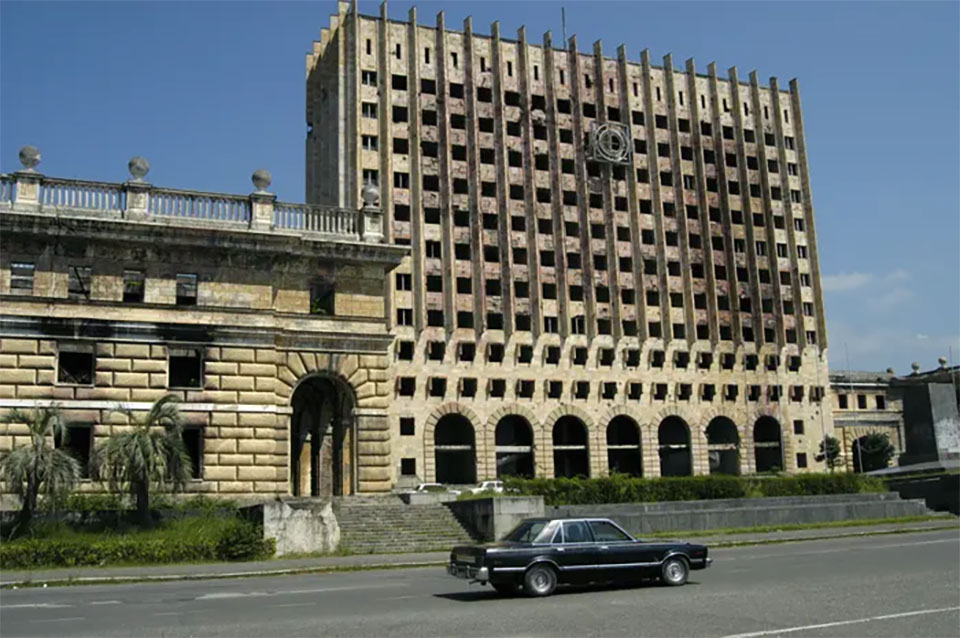
After the victory parade and negotiations in the Russian Federation, the situation was aggravated by the emergence of numerous rumors about the massive sale of real estate to Russian business, as a kind of counter-step by the Abkhaz authorities in exchange for protection and privileges from Russia. Particularly acute was the question of the fate of the main Abkhaz symbol of “independence” – the burned House of Soviets in Sukhumi, where bloody battles took place during the Georgian-Abkhaz conflict. Rumors that they plan to sell it to the Russians, who will convert it into the Intourist Hotel, have stirred up society. Quite fair questions arose about the appropriateness of turning the “shrine” into a hotel, especially against the backdrop of victory parades being held in front of it. Other “wishes”, skillfully inserted into the internal agenda by Moscow to test the reaction of public opinion, also provoked slightly less intense discussion. This includes land in the Gagra region, which has long been eyed by the former Minister of Agriculture and Governor of the Krasnodar Territory, the largest latifundist in Europe, Alexander Tkachev, which is planned to be developed with tourist clusters for VIP clients. This is the half-abandoned airport in Gulrypsha, which is going to be restored by “certain private individuals with the support of the Government of the Russian Federation” according to the same scheme as the Sukhumi airport, which not a single Russian aviation holding company decided to undertake the restoration of, no matter how much they were persuaded. This includes the expansion of the 7th Russian military base in Gudauta and the sale of land near the village of Kyndyg next to the planned naval base in Ochamchiry for the residence of Belarusian President Alexander Lukashenko. Attempts to break the ban on the sale of real estate in Abkhazia to foreigners have been made by Moscow for a long time and persistently. They are usually rejected, since the authorities of Abkhazia know very well how stories end with access to real estate of Russian oligarchs in the neighboring Krasnodar Territory and annexed Crimea, where the seashores are inaccessible to the population and are built up with palaces of “Putin’s friends.”
Moscow will certainly try to use the difficult time to its advantage. The Kremlin decided to shift the active zone of its political influence in the Caucasus to the north, after the final distribution of forces in the South Caucasus. To do this, Moscow uses in the information field not only stereotypes about the threat from NATO in Georgia, but also supplies domestic audiences with narratives about extensive Turkish influence in Abkhazia, which is dangerous for its independence. In Abkhazia itself no one believes them, but outside it works.
The problem of the Abkhaz authorities lies in the dramatic socio-demographic situation that initially developed after the conflict with the Georgian center. The mass exodus and expulsion of the non-Abkhaz population during the first Georgian-Abkhaz conflict of 1992-1993 led to an imbalance in the size of the controlled territory and the number of people capable of effectively developing it. In addition, Abkhazia was under sanctions for a long time, including from Russia, which did not allow it to develop effectively. The Abkhazian population is small, as are individual small diasporas of other peoples who remained or returned to Abkhazia in the 90s. The inability to effectively develop the entire territory on their own is pushing local authorities towards two options for solving the problem, in which dialogue with Georgia is not considered in any way. The first option involves the adoption of the most loyal laws regarding the repatriation to their homeland of the Abkhaz muhajirs – the descendants of those Abkhazians who were forced to leave the Caucasus in the 19th century and today live in the countries of the Middle East, mainly in Turkey. On the one hand, this exit guarantees the construction of a national state with a predominantly Abkhaz population. On the other hand, the Abkhaz diaspora is mentally, socially, economically, politically and religiously closer to Turkey and the Arab states. Mass repatriation to Abkhazia, which its authorities have been talking about throughout their history, is frightening with the very prospects that Russian political scientists talk about for their domestic audience. This will inevitably lead to the Islamization of the region and its complete dependence on Turkey, even more than on Russia today. In this version of the future, modern Abkhaz society will be in the minority in relation to its compatriots, who are close in mentality and culture to the Turks and Arabs.
The second option involves an agreement with all the wishes of Russia, which will make Abkhazia a region completely dependent on it without the ability to maneuver in the political field. We can see a similar situation today in the Tskhinvali region (South Ossetia), which is a vivid example of a failed state, absolutely not viable without the support of the Russian budget and not having any significant weight in independent politics.
Of course, there is still a third option – to wait, maneuver and do nothing. Only the rapidly developing changes in the world leave less and less chances to maintain the status quo and the Abkhaz elites will sooner or later have to make a choice. It seems that the Kremlin understands this well and is trying to present to the Abkhaz elites today the most attractive offer in a hopeless situation, not without the help of the Abkhaz diaspora in Moscow.
BIG GAME IN THE HANDS OF OTHERS
On September 30, 2023, not only Russian troops were present at the parade in Sukhumi. If you look closely at the delegation of the Abkhaz diaspora from Turkey, you will notice that among its participants were representatives of the large Caucasian organization Kaffed (Federation of Caucasian Associations), one of the largest Circassian associations in Turkey.
A day after the parade, on the Georgian-controlled side of the conditional border in Anaklia, the annual poetry festival of representatives of the Caucasian peoples “Anaklia – 2023”, organized by the Circassian Cultural Center of Tbilisi, took place. It is no accident that these dates are so close to each other, since the festival was originally created to draw attention to the care of the Georgian authorities about the national minorities of the North Caucasus. This year the festival in Anaklia was also special. It was attended by representatives of another large Caucasian organization in Turkey – Cherkesfed (Confederation of Circassian Organizations), an alternative to the International Circassian Association, located in Russia and controlled by its special services.
What is the difference between them?
The fact is that the Circassian and Abkhaz diasporas of Turkey, which for some time now have been ideologically split, are actively involved in both organizations. This process began several years ago after some representatives of organizations broke ties with the International Circassian Association, based in Russian Nalchik in the Republic of Kabardino-Balkaria. It was caused by accusations by representatives of the diaspora against the ICA, who announced the organization’s cooperation with the FSB for the purposes of intelligence and propaganda in the Caucasian diaspora abroad. This gap led to a split in organizations into those who wanted to maintain relations with Russia and those who were ready to radically break them. By 2023, associations that disagreed with the pro-Russian position of the leaders, mainly from the youth movement, left Kaffed. On the other hand, Cherkesfed took an even more pronounced anti-Russian position. Thus, from September 30 to October 1, ideological opponents turned out to be at various events in Sukhumi and Anaklia. The complexity of the situation is that since 2022, Turkey for the first time met Russia halfway and banned the annual mourning events of the Circassian public, which irritate the Kremlin, held on May 21 in memory of those who died during the Russian-Caucasian War and as a result of the genocide of the Circassians by the Russian Empire in the 1860s. Then the overwhelming number of mountain Circassian communities were forced to flee en masse to the Ottoman Empire from the Caucasus, which caused quite large-scale deaths from hunger, cold, epidemics and sea wrecks, as well as direct military clashes with the regular troops of the Russian Empire, which destroyed settlements in order to squeeze out the population from mountains This position of the Turkish authorities further aggravated the split, since not everyone was ready to oppose Istanbul’s official agenda.
Taking advantage of this situation, the Russian authorities, starting in 2022, began to actively promote in Turkey a new “historical agenda” about the Circassian genocide, which began to be voiced by Abkhaz organizations loyal to Russia. They held events on May 21, erected monuments and tried in every possible way to show that the events of the 1860s in the Caucasus concerned primarily the Abkhaz people. The historical events of 1861-1864 concerned only Circassian societies and the Abaza people, closely related to the Abkhazians, but still independent. The expulsion and muhajirism of the Abkhazians occurred in two waves – a smaller one during the uprising in 1866 and a larger one at the end of the Russian-Turkish war of 1877-78, when the Turkish authorities used Caucasian muhajirs in Abkhazia, which they managed to occupy thanks to an agreement with the Abkhaz ruling prince from the Shervashidze family . That is, the narrative of Abkhaz memory initially has its own distinct mourning dates associated with resistance to Russia and the forced exodus from the Caucasus. Moscow’s past attempts to influence the “Circassian agenda” directly through Circassian organizations have failed in attempts to play on contradictions in the Circassian diaspora. With the interception of the agenda of the Circassian neighbors by the Abkhaz diaspora, the process of appropriating the “Circassian genocide” agenda, dangerous for the Kremlin, began through controlled groups in the Abkhaz diaspora.
For Russia, this agenda is extremely important because it makes it easy to neutralize the scattered and suppressed voices of the Circassian opposition, which are already quiet today. Moreover, the Circassian and Abkhaz today rank third in number among the non-state peoples of Turkey, after the Kurds and Laz. They have their own media, their own political parties, leaders and representatives in the highest military and law enforcement circles of the countries of the Middle East. Influence on the diaspora allows Russia to influence the policies of Erdogan, as well as the highest circles of Jordan, Israel and Syria.
How far this policy has gone today can be understood from the public statements that Russian political scientists allow themselves to make. For example, Maxim Vaskov, a political scientist and Doctor of Sociological Sciences at the Southern Federal University, Russia’s think tank in the Caucasus in the field of sociology, political science and issues of war and peace, said on the “Apsnykhabar” program in Sukhumi on October 6 that Russia could recognize the Circassian genocide, because in this recognition there is a positive opportunity for dialogue and harmony in the future. On the same broadcast, his thoughts about the mediation potential of Abkhazia were voiced. Until recently, such bold ideas voiced publicly in Russia or from a person from Russia were impossible, since such a person threatened with inevitable consequences in the form of accusations from the FSB of extremism. Today this is said openly and out loud, albeit only in the Abkhaz media for now. This resembles a typical Kremlin test of reaction. In a positive case for Moscow, by May 2024 we will most likely hear amazing statements about the recognition of the Circassian genocide. Most likely, they will first come from the authorities of Abkhazia, and then, as support from Russia.
However, it is necessary to understand that such recognition will be carefully calculated by the Kremlin and will be surrounded by a huge number of “buts”. The Circassian genocide in public statements by the Russian authorities and pro-government academic structures is assessed as a grief that could not be avoided. Guilt for its commission, if admitted, is only indirectly, as a reaction to the actions of “European and Turkish spies” who deceived the naive and gullible ancestors of the Circassians, Abazins and Abkhazians into the army bayonets of the Russian Empire at the end of the Caucasian War. The empire only wanted good things – to bring civilization to the “wild Asians.” Simply put, for the Circassian genocide recognized by Russia, only “European spies” (primarily the British) will be to blame, and, if politically necessary, “Turkish agents” will be to blame if they need to put pressure on “Erdogan’s dear partner.”
This convenient position allows Moscow to intercept the opposition anti-Russian agenda of disparate Circassian groups and activists, and at the same time suppress any attempts to talk about repatriation to the Caucasus for anyone wishing to return to their ancestral homeland. A program for such repatriation legally exists in Russia, but it is subject to a huge number of conditions with no guarantees, so that the flow of repatriates over the past decades has not exceeded several thousand people, most of whom are forced refugees from Syria. Those who arrived a long time ago and even managed to obtain citizenship, for the slightest attempt to express criticism of the Russian authorities, were deported by these same authorities, in some cases deprived of citizenship on formal grounds. Very often, it was Abkhazia that acted as the protector of such repatriates, who were issued Abkhazian documents. Both in the existing laws of the Russian Federation on the repatriation of Caucasians, and in the logic of the future potential recognition of genocide, lies the good old formula, so beloved by the Kremlin, which can be expressed in a simple phrase – “the victim is to blame for behaving incorrectly.”
It seems that this coming spring we will see completely new alignments of forces, ideas and elites in the North-West Caucasus, which Russia is actively turning into its new outpost in the Caucasus. By this time, the Abkhaz elite will have to make their decisive choice for the future at this key crossroads of the era of great changes.