
Despite Donald Trump’s constant attempts to achieve peace and his optimistic expectations, the process has reached a deadlock, and hostilities risk moving into next year.
While the new sanctions are important, they do not change the position on the battlefield and the plans of the Russian command.
Maintaining the current status quo is not enough to stop the war, which will further push American diplomacy into a deadlock due to Russia’s destructive position.
A game changer is needed that will give movement to real negotiations.
Russian coercion is the only way to a diplomatic settlement, and Donald Trump still has the tools to achieve his goal.
Previous experience has shown that attempts to motivate Vladimir Putin with constructive conversation do not yield results. The Russian side continues to stall and exploit its key battlefield advantage – its greater ability to engage targets at a distance and the depletion of the Ukrainian air defense system – in the hope that the Ukrainian defenses will crack.
Equalizing long-range capabilities could be those “game changer” that will force Russia to sit down at the negotiating table on the terms of a ceasefire along the front line – the only possible way to stop the war.
Why is Ukraine fighting for Tomahawks and why is this not an escalation, but a balancing act?
The Russian army is constantly changing its tactics of shelling Ukraine, but the basis of recent operations is the following approach: the most large-scale strikes consist of using several dozen ballistic missiles and several hundred drones.
Such tactics allow the Ukrainian air defense system to be reloaded and contribute to the more effective use of missiles. They can carry a significantly greater explosive weight and inflict much greater damage.
Russia is actively using a new method to destroy the Ukrainian energy system and create conditions for a blackout, hunting for military-industrial facilities and causing terrible damage to civilian infrastructure with numerous casualties among the people.
While Russia feels an advantage in long-range – why would the Kremlin go for peaceful terms? The question is rhetorical.
Ukraine is trying by all possible means to correct this trend.
Firstly, Ukrainian technologies allow the use of drones more than a thousand kilometers behind the front line, which is a significant breakthrough. Such progress allows hitting oil refinery facilities that support the Russian war machine and hitting military facilities.
However, it is worth remembering that a drone will not be able to inflict such a large-scale impact as a ballistic missile. That is why it is difficult for the Ukrainian army to achieve an important goal – to destroy strategic military industry facilities – defense enterprises that produce missiles and drones that systematically strike all regions of Ukraine.
Secondly, the Ukrainian side has achieved some progress in the production of its own missiles – “Flamingo”. However, without technological and financial support from Western partners, it will be difficult to scale up the production of missiles and their quality to a level that will allow systematically hitting Russian military targets at a distance.
That is why it is so important for Ukraine to obtain Tomahawks.
Their use in combination with drones, Ukrainian-made missiles and missiles received from other partners would allow Ukraine to partially catch up with Russian capabilities and more effectively hit military targets. That is the purpose of Ukrainian commandment.
Also, such a decision by the US would be a clear political signal to other allies – in particular, Germany, which is in no hurry to agree to the transfer of Taurus.
As long as one of the sides in the war feels its own advantage on the battlefield – there will be no peace. That is why the transfer of Tomahawks to Ukraine is not an escalation, but a partial equalization of the military potential of the parties in order to create conditions for peace.
In this context, the myth of “Russian propaganda” that American missiles will not change the situation on the front does not correspond to reality.
Giving Ukraine the ability to destroy defense enterprises and logistics on Russian territory would significantly limit their potential to advance directly on certain sections of the front line and strike deep into Ukraine. The Russian military potential will be restricted that will make fast impact on their abilities to continue the war.
The presence of Ukraine’s ability to cause a “blackout” in Russia would deter Russian troops from similar actions against the Ukrainian population, since the destruction of Russian energy even in the western regions would be a significant image loss for Vladimir Putin and this can no longer be hidden from its own population.
Thus, Ukraine is not looking for escalation, but is fighting for a level playing field. Donald Trump’s consent to the transfer of more than 50 units of the above-mentioned missiles would be an effective step aimed at forcing Russia to make peace.
It is clear that the Donald Trump Administration does not seek escalation and Ukraine shares this position. However, declarations from Russia with hints at the possibility of a “nuclear response” through the transfer of American missiles or strikes deep into Russian territory do not stand up to any criticism.
First, the use of nuclear weapons against Ukraine will not give Russia any advantage, but will have significant political consequences – China and India have clearly articulated the unacceptability of such a scenario.
Secondly, the Ukrainian side is ready for full US control over the definition of targets and the implementation of the procedure for using missiles, which ensures full coordination of American partners with regard to all possible risks.
Russian threats are only attempts to thwart the decision to transfer missiles to Ukraine due to the Kremlin’s fears about possible negative scenarios on the battlefield.
Will the already adopted deterrence measures stop Russia?
Sanctions against Rosneft and Lukoil are an important step of the Donald Trump Administration. However, the key aspect is not only the adoption of a political decision, but also the control over its implementation.
It is worth recognizing that the Russian side has successfully adapted to the fact that at the beginning of the year similar economic measures were adopted by the previous US President against Surgutneftegaz and Gazprom Neft. There is reason to believe that Russia will continue to find workarounds. Moreover, even Indian companies have enough tools to buy Russian raw materials through intermediaries and on swaps. Not to mention China, which is increasingly buying Russian oil at cheap prices and does not demonstrate readiness to completely block the supply channel.
Thus, sanctions are a powerful political signal and a blow to the longer term, but not a decisive instrument of coercion that will bring Russia to the negotiating table in the near future.
The Russian economy will lose, but not on such a scale that would prompt Vladimir Putin to immediately cease fire on the front line.
Despite the importance of the long-term strategic effect of sanctions, in the short term they will not immediately change the situation for Russia. That will not bring peace so fast as Ukraine and USA want it.
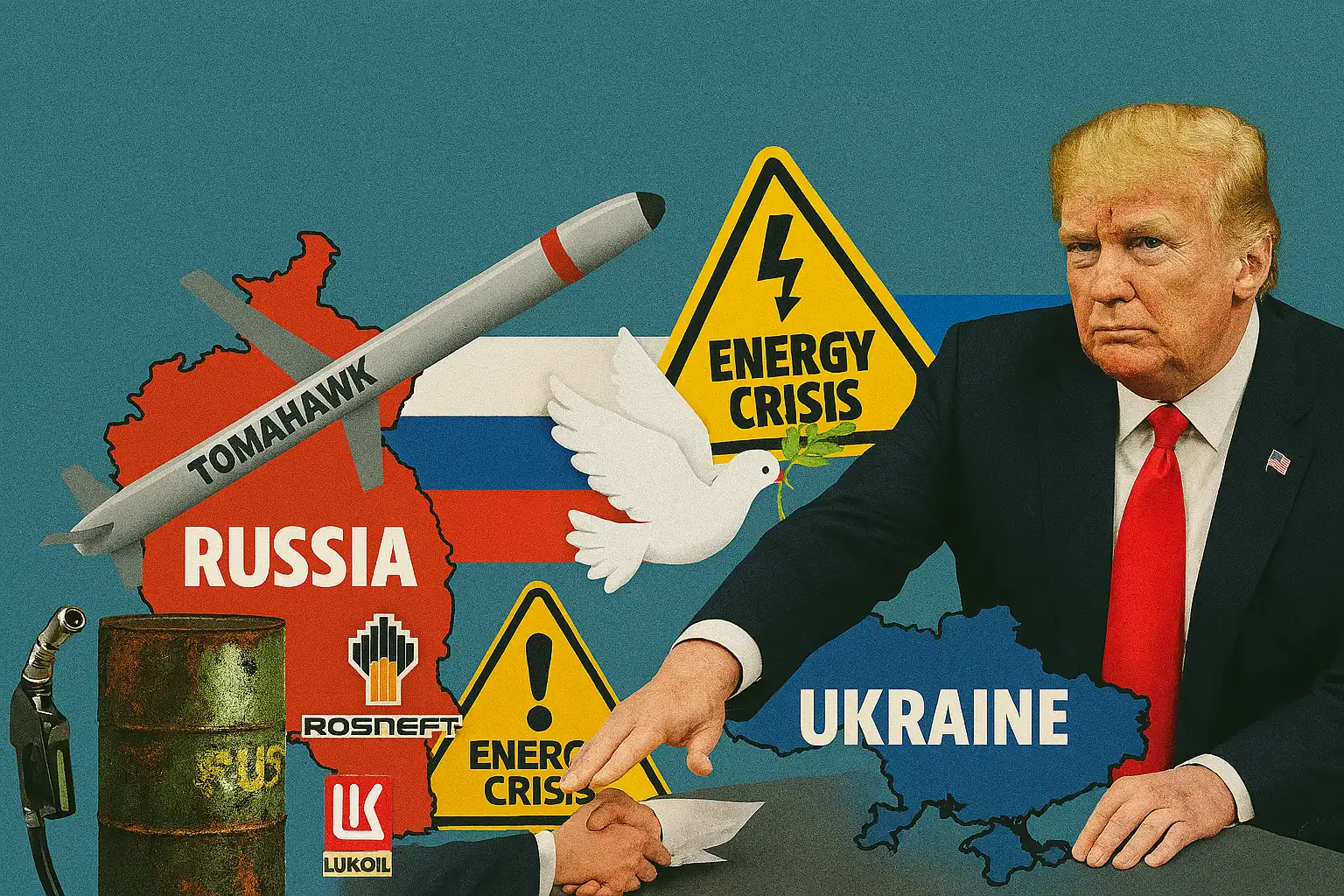
Is Donald Trump really getting closer to a peace deal?
The American administration is taking a consistent position aimed at achieving peace. This is worth recognizing and appreciating. However, if Ukraine’s position is to support a ceasefire without any conditions and peace, then Russia continues to try to use American goodwill in its own interests – victory on the battlefield and laying the foundation for a new offensive against Ukraine in the future.
As long as Russia, like a boxer who feels its own height and seize advantage (long-range punches), does not experience critical weakening (preserving export revenues) and tries to keep the opponent at a distance or exhaust him with constant pressure and clinches.
Only if Russia loses this advantage will the situation change and Vladimir Putin will begin real negotiations without unacceptable conditions.
Donald Trump has a choice of when to force another boxer to stop this fight: in the middle rounds or wait until it reaches the final rounds. A combination of military and tough economic coercion tools can do it shortly.
For now, it seems that a peaceful solution to the war is being postponed, and the blame for this lies not in Kyiv, which has accepted all the calls of the American side, nor in the United States, which is making diplomatic efforts.
Donald Trump still has the “coercion cards” and their proper use will not lead to escalation, but will force the Russians to peace.