
The Zangezur chessboard: the new nature of regional transformations
Alexander Gnydiuk. Leading expert on Central Asia.
The economy is a key indicator of the development of any states and regional unions, which is determined by the circulation of capital, goods and services. In this plane, large logistics routes are gaining enormous importance, and the interests of the biggest players are determined precisely by how and through whose territory they will pass.
If we take into account the Middle East and the South Caucasus, then these regions play a huge role in the transit between Asia and Europe, which affects the formation of new regional alliances. It is this factor that determines the rather illogical partnership between Armenia, Iran, Russia and India on the one hand, and Azerbaijan, Turkey, Israel and Pakistan on the other. In this logic, the formation of new situational alliances will take place, which will determine the level of security and the status quo in Central Asia and the South Caucasus.
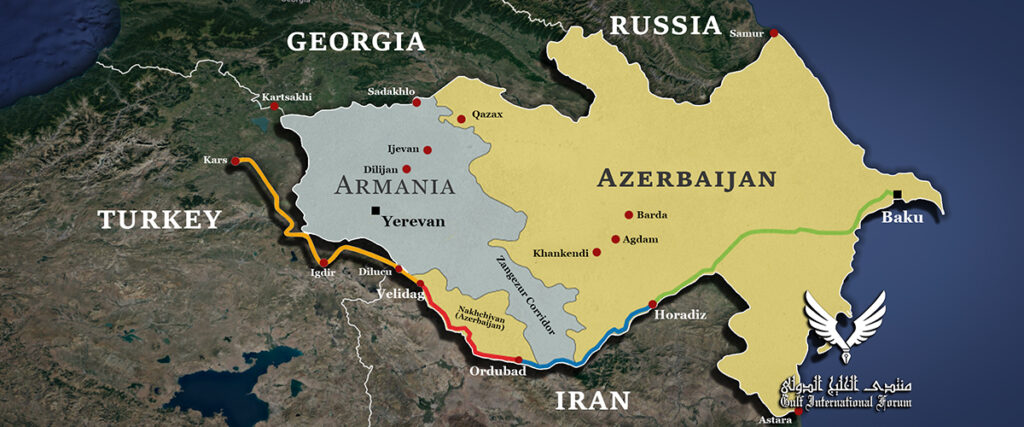
In this context, the key problem point is Armenia, which occupies a rather advantageous geographical position and, despite the lack of natural resources and lack of strategic depth, can use this situation to its advantage. The Syunik region of Armenia, or the so-called region of western Zangezur, will remain a permanent problem for the regional ambitions of Azerbaijan, the territory of which in the 20s of the previous century was very “wisely” cut by the then Kremlin strategists, dividing it into two parts without any land connection – mainland Azerbaijan with access to the Caspian Sea seas and their Nakhchivan Autonomous Region, which is mostly sandwiched between Iran and the same Armenia (a small part borders Turkey).
The “Nakhichevan problem” remains very serious for the Azerbaijani authorities and is constantly escalating under the influence of external threats, similar to the latest escalation of Azerbaijani-Iranian relations. State security agencies of Azerbaijan have launched a series of powerful purges in their Nakhchivan Autonomous Region in order to minimize the risk of subversive activities by regional elites or “clans”. The Minister of Finance of the Nakhichevan Autonomous Republic, Rafael Aliyev, who is related to the previous “owner” of the region, Ramiz Mehtiyev, who was dismissed from the post of the head of the administration of President Ilham Aliyev in 2019, and in 2022 – was forced to resign from the post of the head of the National Academy, fell under such a purge. Sciences of Azerbaijan. Sources close to the administration of the President of Azerbaijan claim that Mehdiyev had close ties with the Secretary of the Security Council of the Russian Federation Mykola Patrushev. If Mehdiyev’s previous resignation was related to the preparation of a military operation to de-occupy Nagorno-Karabakh, the current one may relate to two possible security challenges for Azerbaijan – confrontation with Armenia and potential aggression from Iran (although the risk of a military confrontation between Baku and Tehran has significantly decreased in recent years weeks due to the difficult domestic political situation in Iran and Turkey’s preparation for a possible operation on the territory of Iraqi Kurdistan).
From the point of view of the current security situation in the region, especially after the victory of Azerbaijan in the Karabakh war of 2020, the desire of Baku and Ankara to negotiate with Yerevan peacefully on the opening of logistics corridors in the region without a new escalation is quite understandable. Erdogan and Aliyev proposed different combinations to Pashinyan regarding the Zangezur Corridor with the introduction of the extraterritorial status of this route. In return, Yerevan was supposed to get full access to the Lachin Corridor, which connects Armenia with Nagorno-Karabakh (a territory that has been under the de facto occupation of Armenia and Russia for several decades). However, official Yerevan is not ready to make such compromises and is trying in every possible way to slow down the withdrawal of the Russian peacekeeping contingent (hereafter RMK) from the territory of Karabakh, appealing to the need to grant some special status to this territory already within Azerbaijan, thereby violating the 2020 peace agreement signed after all, Armenian Prime Minister Nikol Pashinyan through the mediation of Russian President Vladimir Putin.
Pashinyan fears reputational damage from the unpopular agreement with Azerbaijan and Turkey and seeks to form new security guarantees for his state with the support of other regional players – Russia, Iran and India, while using a powerful political lobby in the United States and France to increase diplomatic pressure on Azerbaijan in order to preventing potential escalation. The last several rounds of negotiations regarding the Armenian-Azerbaijani settlement (in Prague, Moscow and Washington) showed that the parties are very far from a compromise, despite all the declarative statements about the need to sign a full-fledged peace agreement by the end of the current year.
This will mean increased diplomatic bargaining on the verge of foul / military escalation in the medium term, as all interested players without exception will try to achieve their previously set goals – the stakes will rise. Next, we propose to consider the positions of key regional players from the point of view of strengthening control over the South Caucasus region, which will automatically allow many players to strengthen.
Trans-Caspian trade route
China is acting as the main driving force and sponsor of the project, as the Middle East is interested in strengthening its position in the region, from which Russia essentially originates. In addition, Beijing will be able to establish a reliable transit corridor to Europe and improve bilateral relations with Ankara, which is gradually becoming a system-forming player in the South Caucasus. Kazakhstan, which has a land corridor with the People’s Republic of China and a long and quite successful experience of bilateral cooperation, is interested in the implementation of the project – according to various estimates, Beijing has invested about 60-70 billion dollars in Astana’s economy in recent decades. The newly elected leader of the Republic of Kazakhstan, Kassym-Jomart Tokayev, will strengthen cooperation with China and Turkey in order to guarantee stability and prevent any fatal attempts by Moscow to destabilize the situation in Kazakhstan by force. Actually, during the last visit to Kazakhstan, Xi Jinping clearly stated that from now on the new security donor for Kazakhstan will be the Celestial Empire. Therefore, it is difficult to expect that in a similar situation, and even during the period of stalemate on the Ukrainian fronts, the Kremlin will test Beijing’s patience with Kazakhstan.
As for the next component of the route, it will run across the Caspian Sea through the territory of Azerbaijan / Georgia to Turkey and then to Europe. In this case, Baku and Ankara could use Georgia for transit, given the rather favorable communication in this triangle, but several security risks remain. Georgia is a small state without strategic depth, where more than 20% of the territory is under Russian occupation (Abkhazia and South Ossetia) with a Russian military contingent and, in addition, the very close connection of the Georgian government with Moscow – these are additional risks. On the other hand, the situation is even more complicated with Armenia, which does not want to open the Zangezur Corridor for stable transit between the two constituent parts of Azerbaijan, which actually determines the only possible scenario for getting out of the situation – by force . As a matter of fact, Azerbaijan and Turkey are probably seriously considering such an option, but, still, they are still trying to reach an agreement diplomatically.
“North South”
Next, the following players come to the fore – Russia, Iran and India, who are trying to carve out their place under the sun in terms of convenient and very profitable access to EU markets. The international transport corridor “North – South” should pass through the territory of these three states and connect India with Russian ports in the Baltic Sea. This project was tried to be launched at the end of the 90s, and potentially it looked much more profitable compared to transit through the Suez Canal – as it halved the route and significantly reduced the cost of transportation. However, it could not be implemented in its entirety due to a number of reasons – lack of funding, the concentration of Russian efforts on the sale of raw materials on the European market, and the “lack of interest” of the Celestial Empire. The current configuration, when Russia and Iran are in a serious confrontation with the collective West, and India maintains “neutrality” and tries to strengthen against the background of permanent confrontations with the PRC, allows us to talk about the actualization of this project, but the most favorable situation for this will arise only if the competitive Trans-Caspian route will remain exclusively in the theoretical plane or will be implemented with significant restrictions at the start.
All the listed actors play a key role in disrupting the plans of Turkey first and trying to block the stabilization of the situation in the South Caucasus. This is the reason behind the rather unexpected intensification of military-technical cooperation between Yerevan and New Delhi, which reached a very high level. In particular, consultations at the level of the heads of the defense departments of both countries and new contracts for the supply of weapons have become common place. A similar situation exists for Armenians in communication with Iran. Immediately after the last round of trilateral talks between Putin, Aliyev and Pashinyan, the Armenian Prime Minister flew to Tehran to check his watches with Ibrahim Raisi. And this despite the very ambiguous public conjuncture of this trip – the suppression of protests and the supply of weapons to Russia turned the regime in Tehran into an even more toxic one.
What’s next?
The struggle for trade routes in the region will intensify, and all the listed states will play within the framework of the objective interests we talked about above. This will need to be taken into account when analyzing certain aspects of the foreign policy of the interested parties.
Azerbaijan and Turkey will increase pressure on Armenia in order to sign a full-fledged peace agreement and open the Zangezur Corridor. It is likely that in the near future the Azerbaijani defense forces will conduct a new operation on the territory of Nagorno-Karabakh in the area of responsibility of the Russian peacekeeping contingent (RMK) in order to take full control of the Lachin Corridor. This will allow Baku and Ankara to improve their own negotiating positions and cut off Karabakh from communication with Armenia (this will deprive pro-Armenian forces of support in the region). Potentially, access to the Lachyn corridor can be opened only if agreements are reached on the Zangezur corridor. In any case, Russia is not able to restrain Turkey and Azerbaijan from a force operation, and Iran, despite the constant rattling of weapons on the border with Azerbaijan, is too heavily involved in internal turbulence, and the potential escalation of military actions against the Turkish-Azerbaijani alliance is an extremely difficult and very risky task. .
Turkey will play pragmatically against Moscow, as in other theaters. Ankara may conduct an operation in northern Syria to form a controlled buffer zone on its own southern borders, where more than 3 million Syrian refugees may be resettled. This will create a favorable basis for Recep Erdogan in terms of strengthening his position in the middle of the country against the background of the economic crisis. Also, Erdogan will be able to normalize relations with the regime of Bashar Assad under certain conditions (including autonomy in the territories of Syria controlled by Turkey) – this is a favorable scenario for Putin to get out of the situation from the point of view of the public component, but in reality Ankara will make the most of the weakening of Russia and squeeze them out from Syria and the South Caucasus, along with existing economic pragmatism.
Russia, India, and Iran will provide financial, military-technical, and political support to Yerevan, which, on the one hand, is trying to get rid of Moscow’s influence, and on the other hand, it still depends on the Russian Federation and plays along with their interests, despite quite powerful protection from the United States and France.