
Despite attempts to demonstrate the steadfastness of the Russian economy, its significant decline is evident: it is not for nothing that the Kremlin issued an order to the government and the central bank on the need to improve economic indicators and restore GDP growth rates.
It is no longer possible to ignore or justify the problem, so there is a gradual shifting of responsibility – in case of non-compliance, the blame will fall on the financial and economic bloc.
However, do the Russians have a real resource to correct the situation, and most importantly – will this lead to stopping the war?
The problems of the energy sector will only grow
Russian officials report with some demonstrative pride about the reduction in oil and gas revenues in filling the budget – as a successful result of their own work.
However, in practice, this is becoming an increasingly “headache” for the Ministry of Finance. After all, de facto, in the reduction of revenues from oil companies, one should not look for the positives of diversification, but rather think about the negatives of the growing deficit, which are delicately kept quiet.
For example, first of all, the Russian budget for 2025 was planned with a deficit within 1% of GDP, and according to the results, it is already expected to be at the level of 2.6% of GDP, which became possible not only due to high military spending, but also due to a reduction in oil revenues.
And it is worth emphasizing that the situation for Russia is not favorable for 2026 either.
First, the prerequisites for a significant increase in the cost of oil are not noticeable. The OPEC+ mechanism is exhausting its potential in regulating prices for raw materials. The main player in the cartel, Saudi Arabia, has clearly realized that attempts to further reduce production will not pull prices up, since the supply on international markets remains stably high, exceeding demand. Instead of receiving the desired prices, OPEC+ participants are simply at risk of losing their niche, as other exporters can replace them. It is not surprising that the cartel systematically moved throughout the past year within the framework of the restoration of raw material production volumes, planning only a temporary pause at the beginning of this year.
What does this mean? It is useless for Russia to hope for a radical increase in the cost of oil thanks to OPEC+.
Secondly, sanctions against Rosneft and Lukoil create conditions for expanding the discount on Russian oil to record values.
To understand: if the Brent brand is traded at $ 55-60 per barrel (it is expected to be in the specified price range for the entire year 2026), then the Russian Urals brand with forced discounts was sold at the end of last year within $ 40-45 per barrel.
Despite the fact that Russian exporters expect to adapt to the restrictions and find mechanisms to maintain sales volumes, the burden on pricing significantly reduces budget revenues.
It is likely that from the second quarter of this year, the discount will decrease somewhat under the pretext of establishing and stabilizing mechanisms for selling oil, which has come under attack from the Trump administration, but it will not be possible to completely eliminate losses.
Especially if the budget for 2026 is planned with the price of Russian oil at $ 59 per barrel. Currently, after discounts, the price is approximately 24% lower than expected. A banal calculation gives an idea of the potential scale of the problems.
Thirdly, the international situation does not give grounds to believe that prices will suddenly go up. Even the US military operation in Venezuela did not become a trigger and the market was ready for it.
In addition, despite the widespread opinion “about the fundamental role of Venezuela for the energy market”, this is not fully true. Despite significant reserves, the complexity and cost of production will be given in signs. That is why it is rather premature to say that Venezuela will become a factor for a radical decrease or increase in the cost of oil.
In any case, neither the seizure of the Venezuelan dictator, nor partial attempts to block the exit of tankers from the country by American military vessels, affect market quotes.
Their cardinal change in the direction of increase is possible only in the event of some emergency in the form of a war in the Middle East, etc. Without such “black swans”, the basic scenario will remain the maintenance of prices in parameters that are unfavorable for the Russian budget.
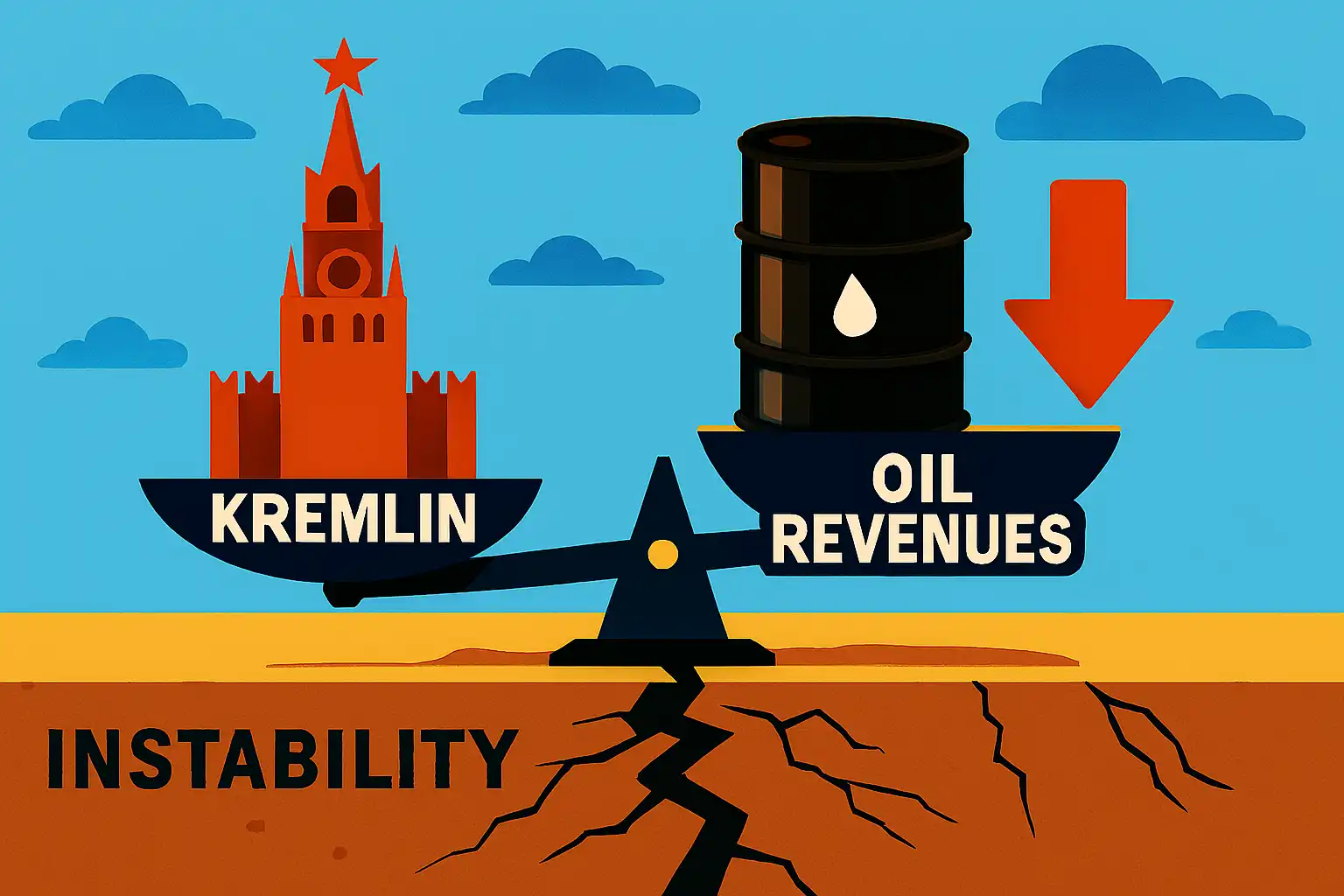
What will this mean for the 2026 budget?
It is difficult to expect the implementation of the Ministry of Finance’s plans to collect funds from the oil and gas sector, as well as the end of the calendar year with a projected deficit.
The deficit is set at 1.6% of GDP or $3.8 trillion. However, with the average price of discount Russian oil at $45 per barrel (which is quite realistic and likely given the circumstances) and the $59 set in the draft budget, the expansion of the budget deficit seems inevitable.
A potential mechanism for formal budget execution could be the devaluation of the ruble, but in conditions of a high central bank rate, reducing the value of the national currency is problematic. In addition, the Kremlin’s order forces the government and the National Bank to reduce inflation to 4-5%, but how to do this simultaneously with the devaluation of the ruble remains an unanswered question.
That is why the key tool of the Ministry of Finance for 2026 is the strengthening of tax collections. In order to support the “proud”, but dubious in real meaning declarations about “reducing the budget’s dependence on the oil and gas sector”, the fiscal burden on the population will have to be increased.
It is not surprising that the value-added tax has reached a record 22%, and the threshold for entering the zone of the specified taxation has been lowered: if it was previously for entrepreneurs with an income of over 60 million rubles per year, now the plan has lowered it to 20 million. This is such a simple formula that was invented to ensure “diversification of oil and gas revenues to the budget”.
Collecting funds from the population is, in fact, the last hope of the Ministry of Finance for budget implementation, since achieving a deficit in 2026 of similar indicators as in 2025 (and the chances of this are significant) will lead to the maximum depletion of the only financial cushion – the national improvement fund. As of 2025, its liquid part is 4.2 trillion rubles, which barely exceeds the planned deficit.
Will the Kremlin stop the war?
Unfortunately, we cannot expect rationality in Russian policy yet. Despite a noticeable deterioration in the economic situation with clear signs in 2026, it is difficult to expect a full-fledged collapse in the next 12 months. This means that populist military-political goals will continue to prevail over economic pragmatism, which will be at least in the first half of the year.
The Kremlin will probably hope that the Ukrainian economy will collapse earlier, but the approved loan from the EU for 90 billion euros will drive such expectations into a corner.
If, in addition, D. Trump instructs OFAC to ensure strict monitoring of compliance with energy sanctions, the Russian economy will face additional difficulties, and India will have to replace raw materials of Russian origin, and not imitate the rapid activity in this direction.
The cumulative effect of all of the above will really help open up opportunities for the negotiation process in mid-2026. Especially, during the mid-term elections to the US parliament.
The problem is that the Russian leadership has repeatedly demonstrated a tendency to irrational approaches: if collapse is not threatened this year, the Russians will not reject the idea of continuing hostilities with the expectation of aggravating problems in Ukraine.
Thus, if economic problems for the Russian budget in 2026 are guaranteed, the Russian leadership is not yet ready to stop the active phase of hostilities.