
Anton Naichuk, Ph.D, the head of East European Council
Farmer protests in Poland are unfolding with new force, which led to the repeated blocking of the Ukrainian-Polish border for cargo transportation. Unfortunately, it is not possible to describe the situation only in “white or black tones”, positioning the actions as exclusively pro-Russian provocations or marginal actions of a limited group of farmers.
The problem is much deeper and complex, which will complicate its quick and painless solution. National protests are not homogeneous and act as a kind of symbiosis of different groups of influence and interests. There is also a big risk in the fact that large-scale demonstrations have not only an economic basis, but also a political undertone.
“Politicization of Ukrainian grain”. If in the autumn “Law and Justice” led a farmers’ protest against Ukrainian agricultural products in order to expand their opportunities in the parliamentary elections, then in the winter of 2024, after the transition to the opposition, individual representatives of the political force did not abandon the previously developed toolkit.
In the spring, local elections await Poland, where “Law and Justice” very much expects to take revenge, and sociology shows low chances for their victory. Therefore, it is not surprising that “PiS” is looking for opportunities to correct the threatening situation and the topic of grain is the best for their traditional electorate – farmers.
It is not surprising that the agrarian organization “Solidarity”, which is close to “PiS”, took the most radical position – blocking the Ukrainian border. Such a step is designed not only to attract the most attention to the problem, but also to “put Donald Tusk on a stretcher”: either he escalates with Ukraine and the EU, taking tough measures, or “PiS” will continue to use the agrarian theme to put pressure on the Prime Minister Minister and receiving individual political dividends.
It is interesting that in the political struggle against the Government, the opposition “PiS” acts in a situational alliance with the “Confederation”. Both political forces will actively use the “Ukrainian factor” in attempts to “destroy the ratings” of Donald Tusk and the Civic Platform.
That is why the opposition political parties of Poland and farmers’ organizations close to them are one of the driving forces of the protests, which will visit for their most negative manifestation in the context of Ukrainian interests – the blocking of borders.
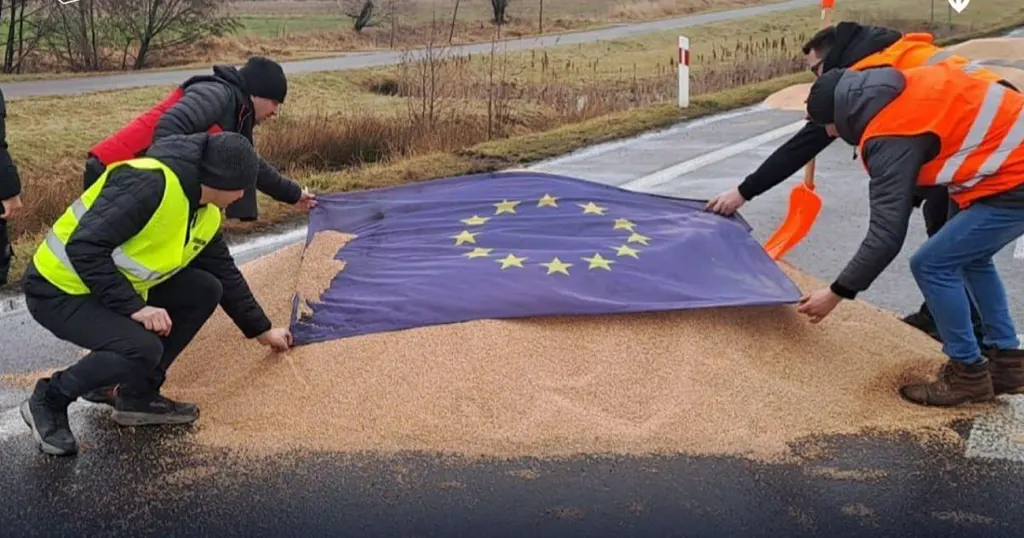
“Polarity of agrarian protests”. It is important that PiS-oriented farmers are not the only component of the national protest movement. Practice shows that among the participants of the actions there are also those who do not support the blocking of checkpoints with Ukraine and give Ukrainian grain a secondary place. Oszukana Wies is an example of such an approach. Activists of the movement oppose EU policy and the so-called “Green Deal”, which does not satisfy Polish farmers. They are a continuation of pan-European protests that are taking place in other EU countries and for the specified category, the conditional “enemy” is not Ukraine, but the European Commission.
It is interesting that this group contradicts the plans of “Law and Justice” to set the tone of the protests and shape their agenda, since these farmers are not against the Government of Donald Tusk, but against the European Commission. Moreover, they consider Janusz Wojciechowski, the European Commissioner responsible for agrarian policy, to be a “traitor”. The latter is a “protégé” of “PiS”, which in 2022 supported the full opening of European markets for Ukrainian products, and in 2023 already changed his approaches when he saw their harm to the interests of his own party.
For “PiS”, such a category of protesters is a threat, because it does not allow them to use protests for political purposes.
The position of the Government of Donald Tusk. Despite the groundless expectations of some commentators in Ukraine, Donald Tusk’s coming to power does not mean radical concessions in matters of agrarian policy, and the February protests are an additional confirmation of the Polish approach to Ukraine: “full support in security matters and pragmatism in economic matters.”
It is expected that Donald Tusk will not put himself “under attack” from the opposition and will not go against the farmers. Moreover, the Prime Minister is interested in speaking from a strong position in order to demonstrate a strong national position, to “knock the card” of the agrarians out of the hands of “PiS” or “Confederation”, and also to transfer them to his own side.
That is why we are observing tough statements and measures from official Warsaw. The Polish leadership not only does not condemn the demonstrators, but on the contrary, focuses on their position. The only thing that Donald Tusk would not want is an escalation on the Polish-Ukrainian border, its further blocking and provocations, so that it does not create problems in communication with Ukraine and, especially, with the EU.
Deputy Minister of Agrarian Policy Michal Kolodziejczak successfully fulfills the role of Donald Tusk’s “right hand” in negotiations and consultations with farmers on the ground. One of the goals is to strengthen the position of the current Prime Minister among farmers. Such an approach will not only pay dividends in the short term – a convincing victory in the local elections, but also in the strategic perspective – strengthening Donald Tusk’s position as a strong national leader.
The Polish side has already initiated quality checks of Ukrainian grain that will transit through Polish territory. It should be expected that strengthening the work of customs officials will become one of the elements of Donald Tusk’s agrarian policy in the Ukrainian direction.
Summarizing the situation, it can be noted that Ukraine and Poland will have to hold more than one hour of consultations to resolve the “agrarian issue”. And this is only the tip of the iceberg, as Ukraine will have to make significant efforts to realize its European integration aspirations in order to synchronize its own agricultural sector with Poland. In turn, official Warsaw will express another recommendation or claim, because the agricultural industry is a strategic component of the Polish economy, and not just a tool in the hands of one or another political force.