
Associative expert of the East European Council, Vitalii Shtybin
On August 3, 2023, Armenia ratified the Rome Statute, which finally put an end to the long debate about its future geopolitical position. By this point, the history of Nagorno-Karabakh, as a separate political unit, was almost over. From the first day of the new year 2024, it must finally return to the control of Azerbaijan. And if nothing extraordinary happens, this process will go quite routinely.
Turning to the events of the second Karabakh war in 2020 from the perspective of today, we can confidently say that this was the first attempt to change the status quo that had been established for decades on the part of Azerbaijan and Turkey. Then the basic parameters of the balance of forces and interests were laid down, which formed into a single puzzle in the fall of 2023. Azerbaijan, with the support of Turkey, worked long and productively with all interested parties through diplomatic channels and diaspora relations, so that at the right time everything would turn out the way it did. It is difficult not to notice the success of this work. New historical realities caused by the war in Ukraine have led to a unique consensus among all regional players and, most importantly, the leadership of Armenia itself regarding the fate of Karabakh.
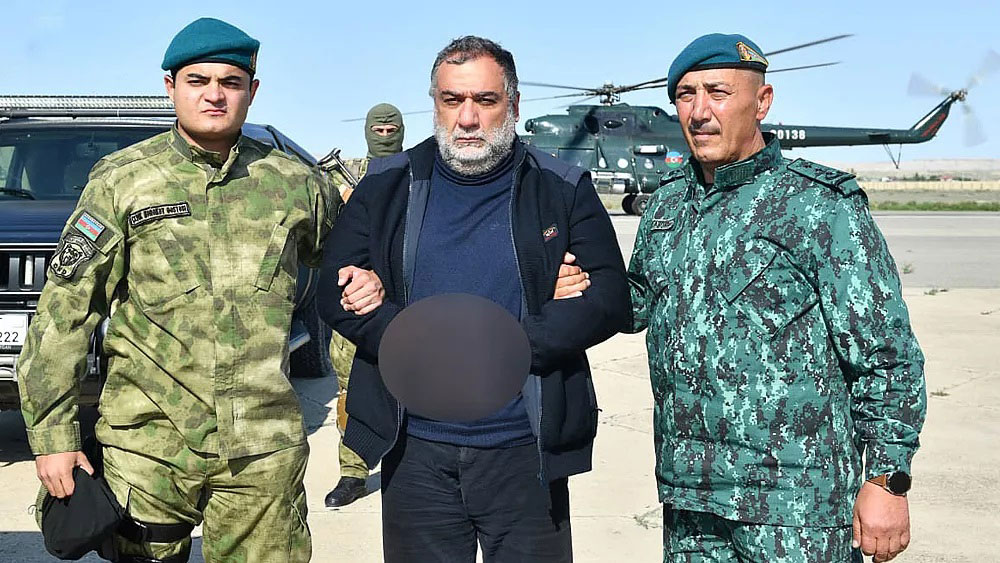
The Russian side, being the guarantor of a truce in the region, has been trying in recent years to stall for time and delay negotiations in order to transfer the region to Azerbaijan for maximum benefit. But there were also different opinions in the Russian position. One of the main proponents of the policy of non-acceptance of new agreements on the part of the so-called “Moscow clan” of the Armenian elite was the Russian oligarch of Armenian origin Ruben Vardanyan, Minister of State of the Nagorno-Karabakh Republic since November 2022. Judging by the fact that he, like some of the other members of his team, was arrested by the Azerbaijani authorities without much indignation from the Russian and official Armenian sides, the policy of delaying negotiations was largely presented as a decision exclusively by local authorities, not related to Russian or Armenian interests, and had the character of a backup option, something like a bonus in a hopeless situation. It was initially a risky business, the way out of which walked a very fine line. With a successful finale, Ruben Vardanyan and his colleagues could become a serious political counterweight to Nikol Pashinyan, having behind them the background of a team that “stood until the last for the freedom of Artsakh.” But it all ended suddenly and decisively when Azerbaijan considered it possible to end this policy with a quick military-police operation. Thus, no matter how paradoxical it may sound, Azerbaijan, through its military operation, saved Nikola Pashinyan’s “Karabakh clan” from direct and most dangerous competitors from the “Moscow clan.” How did this consensus come about?
CROSSROADS OF INTERESTS
Modern Armenia is in a difficult political situation, trying to maneuver between public opinion that wants to continue the struggle and external pressure aimed at accepting the status of a loser. This led to a split in internal forces trying to use the contradictions for active internal political struggle. In this situation, the political leadership is trying to conduct a dialogue with different parties, gain time, and show flexibility, step by step conducting negotiations with Azerbaijan and Turkey at various mediation platforms. Hence Yerevan’s contradictory statements and relations with its neighbors – Russia and Iran, whose presence in a military sense is perceived positively, but insufficiently on one side of the spectrum of opinions and completely unacceptable on the other.
If we look at things through the eyes of these neighbors, we will see a complex tangle of relationships in which the interests and fears of all parties were almost balanced by the end of the Karabakh history. On the one hand, there is the Russia-Armenia-Iran line, in which Armenia is more of a hostage to the situation than a full-fledged partner. It is very important for Russia and Iran to preserve Armenia as an integral subject of politics, subordinate to their interests. Until the fall of 2023, a large flow of parallel imports, especially automobiles, passed through Armenia. After Georgia was partially connected to Western sanctions and the secret appointment of American specialists with the right to a decisive vote at its main transport posts, this path was blocked. However, there is still open airspace that Russia is using to circumvent sanctions, albeit at great cost.
The same thing works in the opposite direction in favor of Iran, which is vitally interested in preserving Armenia as an independent player much more than Russia. After 2020, the confrontation between Armenia and Azerbaijan emerged at the level of their main allies – Iran and Israel, existential enemies. Israel actively supplied and advised the Azerbaijani army, which was perceived extremely painfully in Iran and led to permanent threats, border exercises, and the growth of anti-Azerbaijani propaganda. There is an additional side to this reaction related to Azerbaijan’s active use, with the support of Israel, of Iran’s Turkic minority. In 2020-2022, there were very active protests in Iran, which developed into demands for independence, among residents of the provinces of Iranian Azerbaijan in the west of the country, populated mainly by Azerbaijanis and Kurds. These protests were perceived by the Iranian authorities as direct interference from neighbors with the support of Israel, and this opinion actively responded to the rhetoric of some popular pro-Turkic news channels that openly supported protests and separatist sentiments in the Turkic provinces of Iran. The result of these events was the attack on the Azerbaijani embassy in Tehran on January 27, 2023, which led to casualties and a crisis in relations between the countries.
However, during the year, Azerbaijan, with the support of Turkey and Russia, negotiated with Iran to normalize relations, which allowed the parties to agree on positions on Nagorno-Karabakh. Although at the same time, the impact of this information campaign turned out to be so serious that the issue of oppression of minorities in Iran reached the international level. Even the usual Iranian agenda of oppressing women’s freedom of expression is now gaining additional context, as in the case of the awarding of the Nobel Peace Prize to Iranian human rights activist Nargiz Mohammadi from the Iranian Azerbaijan province, best known for its national protests.
The result of negotiations between the two countries was the visit of a delegation of the Iranian Armed Forces to Azerbaijan in early September 2023, on the eve of the end of the Karabakh conflict. As a result, during Azerbaijan’s military-police operation in Karabakh, Iran took the position of a cautious observer, designed to ensure that the conflict did not affect the territory of Armenia, as an important ally.
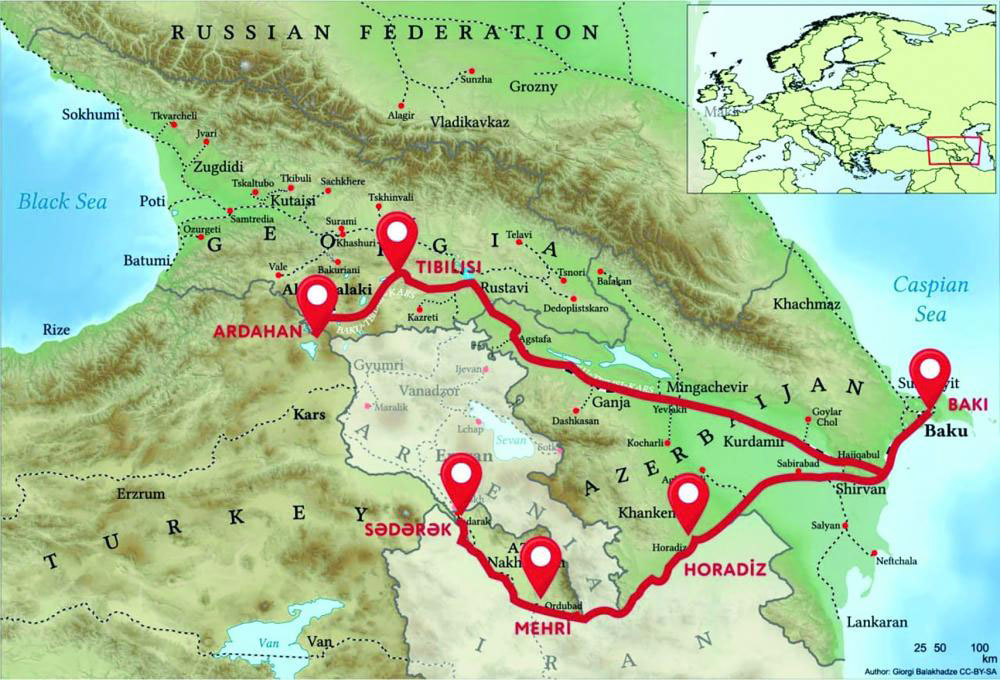
On the other hand, there is the Azerbaijan-Armenia-Turkey line, in which Armenia occupies exactly the same position as a forced participant. It is vitally important for Azerbaijan and Turkey to unblock communications for a direct logistics route both between them, including the Azerbaijani enclave in Nakhichevan, and in general along the China-Europe trade communications line. Already today there is an active struggle between competitive projects between India and China in Europe. The first path involves the creation of a single route India-Pakistan – the Persian Gulf countries – Iraq – Turkey and then Europe. He has significantly increased Turkey’s attention to Iraq and Syria. The second route runs from China through Central Asia and the South Caucasus, also to Turkey. This project shows the significant participation of China, which, through its own specialists and companies, is implementing large-scale infrastructure projects in Georgia.
Of course, all these actions and ideas give rise to competitive struggle between the parties. However, if we take a closer look at the planned projects, we can notice that all these logistics routes are beneficial to all parties to one degree or another. For example, Russia, Turkey and Iran are promoting their branch railways through Azerbaijan in the North-South and Turkey-Russia directions. That is, the contours of a potential construction boom in the field of infrastructure in the South Caucasus are already visible today. And the key point of all these routes is the Zangezur corridor, around which the main military rhetoric of recent years has unfolded. All potential trade routes pass through it. Turkey and Azerbaijan are so confident in unblocking it that they have already brought a ready-made transport route to its borders. On the other hand, Iran, seeking to curb Turkey’s active influence in the region, is trying in every possible way to offer Azerbaijan alternatives in order to prevent Turkey from opening a direct trade route with the unblocking of the Zangezur corridor, even if this would be unfavorable for its key ally, Moscow. This is manifested in the active construction of border bridges and reconstruction of highways connecting the Nakhichevan enclave of Azerbaijan with its main part through Iran, bypassing Armenia. All this activity around Zangezur reproduces fears of losing the region, which greatly influence public opinion in Armenia itself. The emerging consensus of the parties today has led to a situation where it is beneficial for everyone to maintain calm and security in this key region of Armenia, while maintaining a political force that is understandable and familiar to all parties in the person of Nikola Pashinyan and his team. However, even here there are pitfalls, which we will discuss below.
It is also worth noting the positions of countries external to the region interested in the Karabakh issue – the USA and France. One can clearly see how the policies of these countries are influenced by the vast and influential Armenian diaspora, which still has not understood the new realities of recent years. Anti-Azerbaijani and anti-Turkish speeches, demands to preserve independent Artsakh, high-profile information campaigns and media stories – all this seriously contrasts with both the real facts on the ground and with the positions of the majority of states in the world, which recognize as fair Azerbaijan’s demands for the restoration of territorial integrity while respecting the rights of the Armenian minority. But even here there is a noticeable difference in approaches. The United States limited itself to military exercises only, in order to show support for Armenia itself in the conditions of a possible interstate conflict. Currently, there is a significant adjustment in the internal political position, which has already led to the resignation of some representatives of the pro-Armenian lobby in Washington. On the other hand, France took a direct part in helping Armenia’s intelligence services, supplying weapons to its army, and also opened a separate consulate in the Zangezur corridor (also known as the Syunik region), thereby confirming its direct desire to protect Armenia in the event of a conflict. The increasingly harsh rhetoric of the French elite towards Baku shows France’s desire to turn Armenia into a proxy state to promote its interests in the region, as a counterbalance to both Turkey as a potential enemy and Iran as a potential competitor. Thus, the policies of these countries introduce an additional dimension in the relations of regional players, which allows the Armenian authorities to more freely pursue a multi-vector policy without exposing themselves to the risk of total dependence on any one of the parties.
NEW SOUTH CAUCASUS
From September 19 to 20, the history of the long Karabakh conflict, which at one time triggered the collapse of the USSR, ended. And just as the events of 1987-1994 became the starting point of the post-Soviet era for Armenia and Azerbaijan, so the events of 2020-2023 began the era of the New South Caucasus of nation states. Its outcome may still be different, but the very fact of the transition to a new reality is obvious. Both states finally got rid of the problematic issue that prevented and conditioned negotiations at various levels. From 2024, any discussion of regional development projects will become simpler, as many experts believe. At the same time, there are a number of security threats that will play a serious role in the region for a long time.
The Armenian leadership has been preparing for a similar outcome of events in recent years. Therefore, the resettlement of almost one hundred thousand Karabakh Armenians occurred so quickly and in a relatively organized manner, without mass casualties and clashes. In Armenia, appropriate refugee reception programs were being prepared and residential buildings were being built. Of course, it is difficult to quickly provide such a mass of population with everything they need, but the process is proceeding quite calmly. At the same time, there is an active search for a foothold for the country’s economic independence, expressed in very active support for IT technology development programs. This applies not only to preferential conditions for IT companies, but also to the construction of international-level IT hubs, as well as the active promotion of IT professions and business in society, through the creation of popular programs in the format of American models, where established IT investors are publicly considered start-up projects.
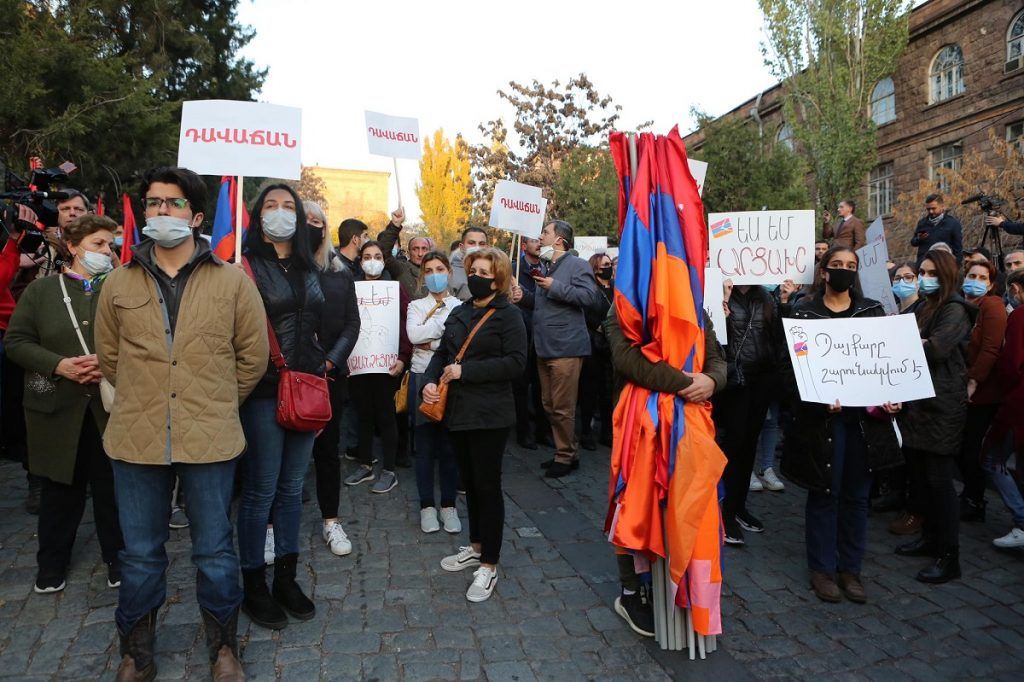
As one would expect, the refusal of the Armenian authorities to support Karabakh and the actual recognition of the legality of Azerbaijan’s actions to regain control over it led to a crisis of power in the country. In the very first days after the end of the military operation, active rallies and clashes with law enforcement agencies began in Yerevan. The protesters split into two different groups. Some demanded a change of government, as having “sold out to the interests of Turkey,” others demanded a severance of relations with Russia, as “having betrayed the interests of the Armenians of Artsakh and not protecting them.” These two groups reflected two polar attitudes of society, conditionally supported by France and Russia, each based on its own interests. Therefore, they held rallies in different places – at the Parliament and at the Russian Embassy. From the very first days of the rallies, the influence of the “Moscow clan” in the information field was noticeable. Bloggers associated with Russian propagandists actively encouraged people to take to the streets to overthrow the government, coordinated actions of disobedience to the authorities, assisted in transporting those wishing to participate in rallies from the diaspora, worked to cover events in the right way, and supported opposition parties for the purpose of unification. However, as events developed, it became clear that the actions were stalling, government officials were responding harshly and decisively to attempts to organize long-term rallies, and opposition leaders were unable to develop a unified policy of action. The idea of overthrowing Pashinyan for the sake of overthrowing Pashinyan, without any specific program, turned out to be unable to become a catalyst for uniting those dissatisfied with the policies of the “Karabakh clan.” Emotions gradually subsided and gave way to the need to organize in support of massive flows of refugees. The opposition did not dare to imagine images of the future, since any political maneuver in this near future presupposes the inevitable signing of a peace treaty with Azerbaijan and the unblocking of communication routes with Turkey. The party in power today is in a more advantageous situation, since for Nikola Pashinyan such actions cannot seriously undermine his reputation, which had already fallen after refusing to support Karabakh. At the same time, for any other leader such a step would result in failure. Therefore, the opposition has no great desire to take Pashinyan’s place until all painful issues are resolved. And here are the roots of Nikola Pashinyan’s decisive actions, increasingly turning Yerevan’s policy towards a multi-vector form, including through expanding contacts with Ukraine and the Belarusian government in exile of Tikhanovskaya.
As for Azerbaijan, now its society and power elites are in a state of euphoria, which can benefit the country’s economic projects and its overall development. But at the same time, it is necessary to take into account the fact of aggressive propaganda towards Armenia and the Armenian society, which has prevailed in society for a long time and can create a dangerous precedent in which the desire to “finish off the enemy” and the feeling of one’s own invincibility will prevail among the elites, or create such a request in a society that the elites will find difficult to ignore. Already now one can hear talk about the historical West Azerbaijan, the need for the return of Azerbaijanis expelled from Armenia in the early 1990s, including pressure on EU countries to include this issue on the political agenda, promises of a marginal fate to the remaining Armenians by radical Azerbaijanis in social networks, and also raises the question of the historical affiliation of the Zangezur corridor. All these conversations negatively affect the constructive agenda of negotiations between the two countries and only further push Yerevan towards a multi-vector policy, search for additional allies and appeal to international organizations for protection, such as the International Court of Justice in The Hague, where the hearing of the case at Yerevan’s request will take place on October 12. Whatever Russian propaganda may say about the reasons and consequences of Yerevan’s ratification of the Rome Statute, it primarily concerns relations with Baku. It is unlikely that anyone sincerely believes that Putin will ever come to visit a country whose elite the Russian authorities consider unreliable and pro-Western. Putin is paranoid about any contact that could even remotely pose a threat to him. Yerevan’s adoption of the Rome Statute is primarily due to the need to provide a legitimate way to call upon the international community to defend itself in cases where Baku decides to take more radical steps both towards the Armenian population remaining in Karabakh and towards Armenia itself in a potential conflict.
UPDATE AFTER THE WAR
In the future, it seems that Armenia has no maneuver left for a too independent policy, and it will be forced to gradually open up more and more to large economic and logistics projects of Turkey and Azerbaijan, turning into an intermediary state. At the same time, the efforts of the Armenian authorities to develop a multi-vector policy, taking into account the interests of various parties, helps to some extent alleviate dependence on one or another neighbor, while maintaining until the end conditional participation in organizations allied with Russia without an actual presence.
Armenia is a predominantly mono-ethnic state, so the issue of ethnic politics does not arise there, with the exception of the topic of the return of Azerbaijanis, which is actively used by Baku to put pressure on Yerevan. An exception may also be the “Jewish question”, if the fact of an attack on the only synagogue in the country is confirmed. However, during the events in Israel on October 7, 2023, Armenian publics already showed a high level of anti-Semitism. At the same time, the country is very actively using the diaspora resource to promote its interests in the world, and is also trying to use it to put a rather weak economy on a modern footing through the accelerated development of the IT industry. However, recent events have led to a deep social split, which has not yet spread to elite circles due to their rational view of the problems and prospects of the country in the new conditions. We can note attempts to undermine the situation on the part of the “Moscow clan,” which has long influenced politics through Nagorno-Karabakh, but it seems Moscow itself today is not ready to support them with more than information, using propagandists to create the necessary negative images of Nikola Pashinyan and his team. In general, the created status suits Moscow, which would like to have a leader in Yerevan who is more dependent on it, but does not have the resources for a serious confrontation. This weakness has already been noted by Tehran’s allies, who, through some information channels, disseminated information about bewilderment and dissatisfaction with Moscow’s inaction to defend its interests in the South Caucasus.
The third party in this conflict is the Western Armenian diaspora, which is more radical, but has lost understanding of the real agenda in the region. Its attempts through France and the United States to influence the situation today are likely to prevent the parties from finally coming to an agreement on future steps, since they contradict not only the interests of all parties in the region, but also the international community as a whole, in which there is a relative consensus in favor of Baku.
Separately, it is worth noting the growing influence of such a phenomenon as “crypto-Armenians” – Turkish youth who have discovered their Armenian roots, from the point of view of their increasing inclusion in interaction on issues of culture and politics of memory between the two countries. However, scandals with the installation of memorials dedicated to the genocide and resistance groups in Armenia, as well as active lobbying for recognition of the Armenian genocide, today prevent the parties from revealing the full potential of cultural interaction.
On October 5, in Spanish Grenada, representatives of Yerevan and Baku signed a peace declaration with mutual recognition of the borders of states based on maps of the USSR General Staff. Approval of a potential peace treaty is expected to be made at a separate meeting in late October. In this regard, even in pro-Russian Armenian public pages, information appeared about the alleged departure of Russian peacekeepers from Azerbaijan before November 1, 2023. And although this information was actively refuted, it was accompanied by news about the closure of three peacekeeper posts as unnecessary, as well as Putin’s statements at a meeting in Valdai that the peacekeepers were only obliged to observe, they had no other functions.
Today it becomes obvious that after the exodus of the majority of the Armenian residents of Karabakh to Armenia, the peacekeepers are becoming an absolutely meaningless force within the region. This impression, together with the feeling of transition to a new era, especially worries the leaders of other unrecognized states of the post-Soviet world, who are trying on the fate of Nagorno-Karabakh. This is manifested in the intensification of meetings between their leadership and the Russian elite, which, as in the case of Abkhazia, are actively surrounded by rumors about the expansion of the “umbrella of the Union State.”
So far, however, the Russian authorities have limited themselves to only statements about the potential opening of a naval base in the Abkhazian Ochamchira, as if marking a new border for the narrowed space of Russian influence in the South Caucasus and determination to defend these new borders. The main question is: for how long?